



The Ethereum Foundation paired a $10.2 million ether sale with a sweeping new manifesto this week, signaling that while it still helps fund the network’s development, it no longer sees itself as Ethereum’s central authority.
Ethereum Foundation Sells $10.2M in ETH to Bitmine as New Mandate Redefines Network Stewardship
WRITTEN BY

SHARE

The $10.2M Ethereum OTC Deal
On March 14, the Ethereum Foundation (EF) confirmed it completed an over-the-counter (OTC) sale of 5,000 ether to Bitmine Immersion Technologies, a publicly traded company listed on the NYSE American under the ticker BMNR and chaired by Fundstrat co-founder Tom Lee. The deal cleared at an average price of $2,042.96 per coin, placing the transaction value at roughly $10.2 million.
The EF disclosed the sale in a thread posted on X, noting that the funds will support its core operations, including protocol research and development, ecosystem growth initiatives, and community grant funding. The organization added that the transfer originated from its Safe multisignature wallet and followed its formal treasury policy, first outlined in June 2025.
That policy aims to maintain a fiat or fiat-like buffer sufficient to cover approximately 2.5 years of operating expenses, with annual spending targeted at around 15% of treasury value. The approach reflects a pragmatic reality: nonprofit foundations overseeing major open-source projects still need predictable budgets, even when their treasuries are largely denominated in digital assets.
The OTC structure also ensured the transaction avoided disrupting the open market. At the time of the announcement, ether traded near $2,100, modestly higher on the day. OTC deals are commonly used for large transactions precisely because they allow buyers and sellers to negotiate privately rather than pushing sizable orders through public exchanges.
Bitmine Immersion Technologies has been steadily expanding one of the largest corporate ether treasuries in the market. At the time of the purchase, the company reportedly held about 4.53 million ETH—valued at more than $9 billion—alongside smaller bitcoin and cash positions. The latest acquisition adds another block to that already sizable pile.
For Bitmine, the purchase represents both treasury management and a show of support for the Ethereum ecosystem. For the EF, it is another step in a treasury diversification strategy that has included a July 2025 OTC sale of 10,000 ETH and the staking of as much as 70,000 ETH to generate yield.
The EF still controls a significant reserve of roughly 170,000 ETH, meaning the latest transaction barely dents its overall holdings. Still, the move reflects a careful balancing act: funding ongoing development without relying exclusively on crypto holdings whose valuations can fluctuate dramatically.
The Ethereum Foundation’s Strategic Mandate
The sale landed just one day after the EF released a 38-page strategic document titled “EF Mandate,” a sweeping attempt to define the organization’s role in Ethereum’s future. Published on the EF’s blog, released as a downloadable PDF and permanently stored on-chain, the document reads like a blend of constitution, philosophy, and operational guide.
At its core is a message that might surprise newcomers but will sound familiar to long-time Ethereum observers: the EF does not consider itself the owner or governing authority of the network. “The Foundation is not the parent, owner, or ruler of Ethereum,” the document states. Instead, the EF now describes itself as “one of many stewards” responsible for helping the ecosystem thrive.
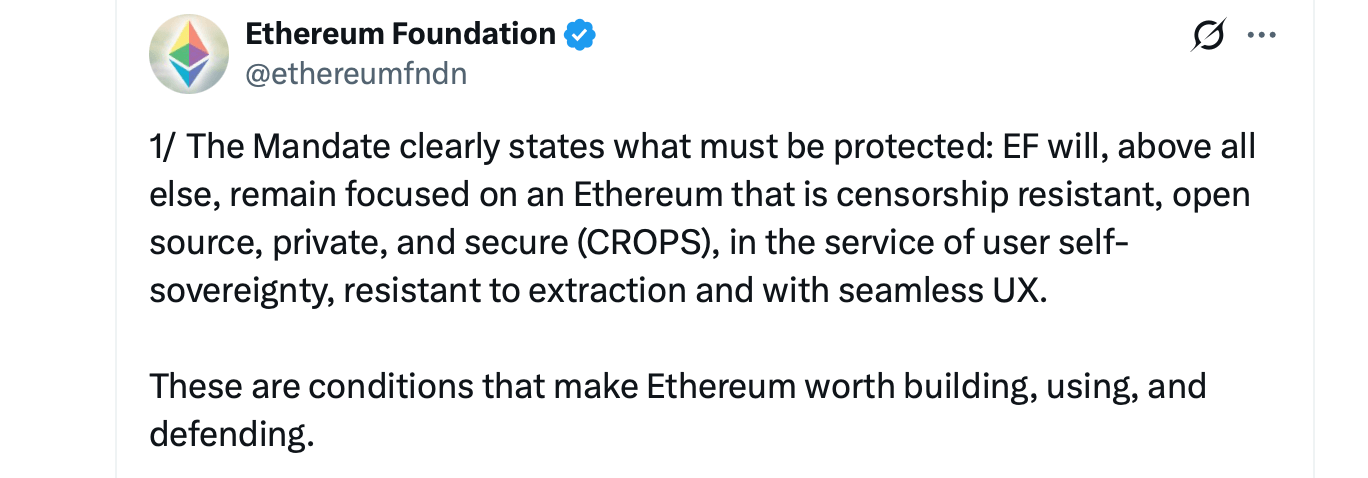
The mandate outlines five guiding principles summarized under the acronym CROPS: censorship resistance, resistance to extraction, open source and free software, privacy, and security. These pillars, the EF argues, are essential to preserving Ethereum’s promise of user self-sovereignty and decentralized coordination.
The document also introduces what it calls the “walkaway test.” Ethereum’s core infrastructure, the EF says, must ultimately become resilient enough that the network could continue functioning even if the foundation and today’s core developers disappeared entirely.

Ethereum derivatives positioning shows growing bearish pressure as Binance funding rates remain in negative territory, highlighting sustained short dominance and…
Read Now: Ethereum Shorts Pile in as Binance Funding Rates Turn Deeply Negative

That idea may sound dramatic, but it captures Ethereum’s long-standing ambition: a decentralized system designed to outlive any single organization. In that sense, the EF’s manifesto and its treasury moves tell the same story—an institution slowly stepping back while ensuring the resources exist to keep the network evolving.
Together, the announcements highlight a dual strategy playing out behind the scenes. On one hand, the EF is managing its balance sheet with the discipline expected of a long-running nonprofit stewarding a global technology project. On the other, it is publicly reaffirming that Ethereum’s ultimate authority rests not with a foundation, but with the broader ecosystem that now builds, secures, and uses the network.
FAQ 🔎
- Why did the Ethereum Foundation sell 5,000 ETH?
The EF sold the ether to support operational funding such as research, grants and ecosystem development. - Who bought the ETH from the Ethereum Foundation?
Bitmine Immersion Technologies, chaired by Tom Lee, purchased the 5,000 ETH through an OTC deal. - What is the EF Mandate document?
The EF Mandate is a 38-page strategic framework outlining the foundation’s philosophy and long-term role in Ethereum’s development. - Does the Ethereum Foundation control Ethereum?
No, the EF states it is only “one of many stewards” and does not own or govern the Ethereum network.