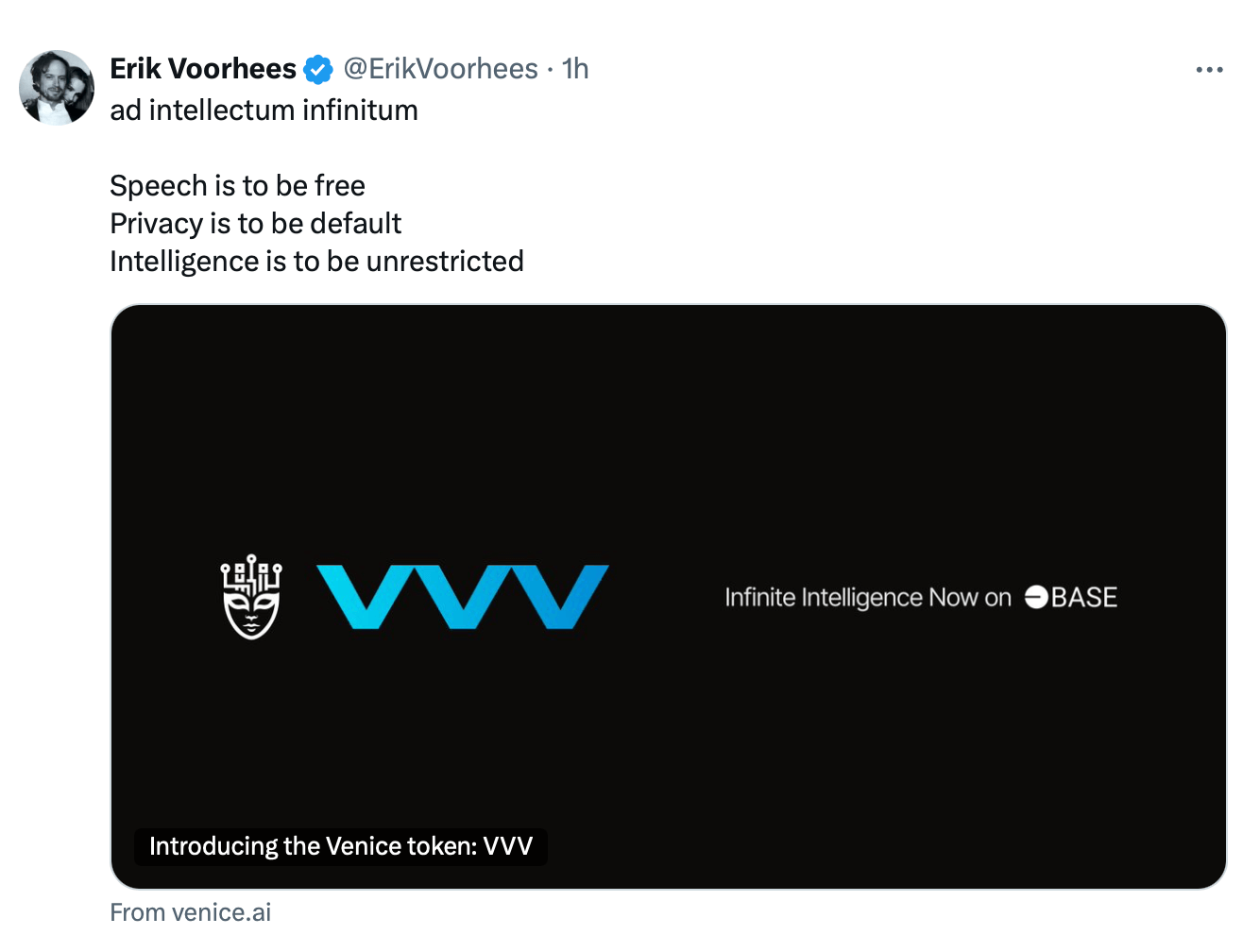
Erik Voorhees, founder of privacy-focused AI platform Venice.ai and crypto exchange Shapeshift, has revealed the launch of VVV token, designed to decentralize access to uncensored AI inference while eliminating per-request costs.
Erik Voorhees’ Venice.ai Debuts VVV Token to Combat AI Censorship, Surveillance

This article was published more than a year ago. Some information may no longer be current.
WRITTEN BY

SHARE
Privacy-Focused VVV Token Targets AI Agents with Zero-Cost Inference Model
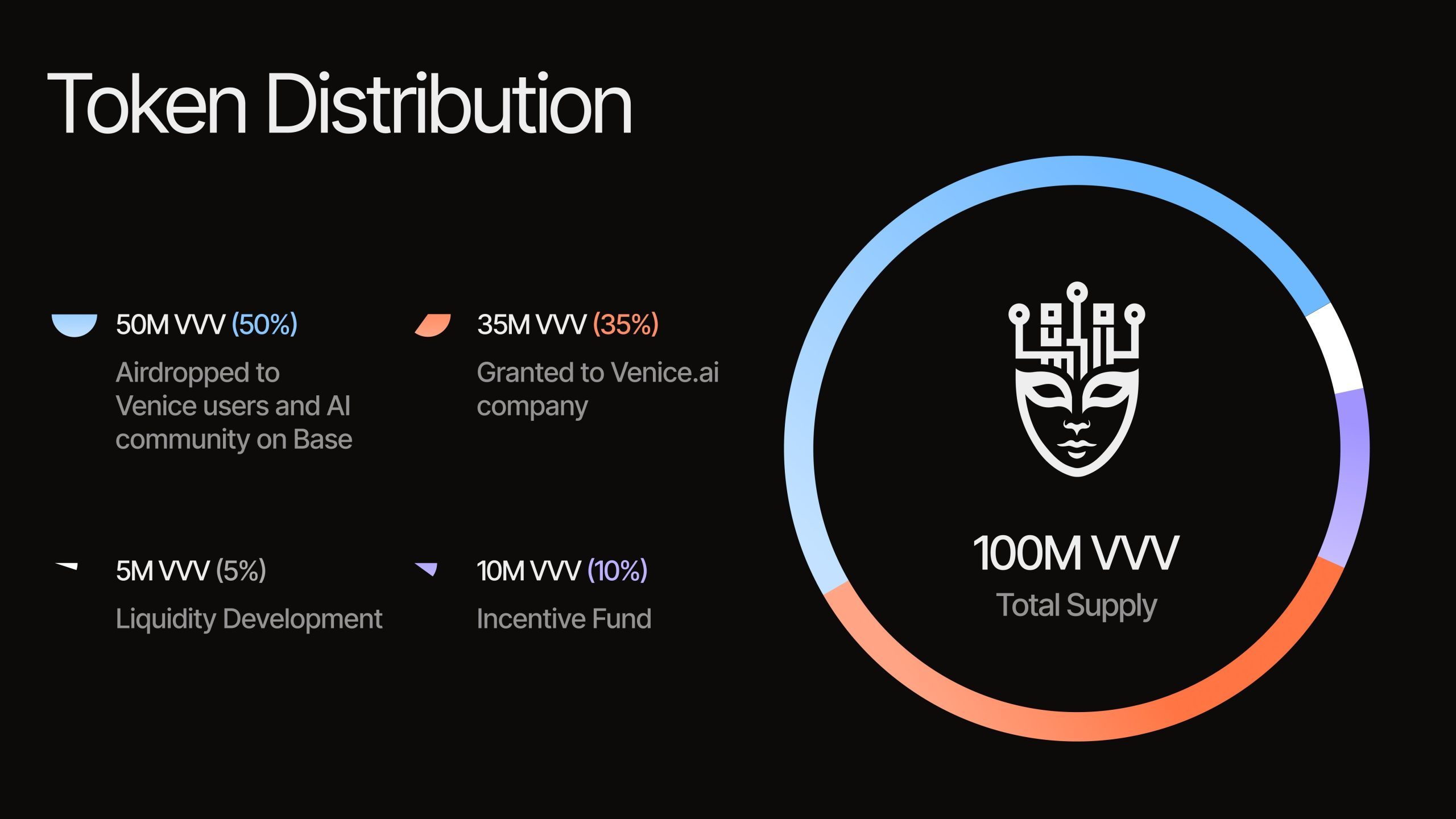
Venice.ai, a decentralized generative artificial intelligence (AI) platform launched in May 2024, introduced the VVV token on Jan. 27, 2025, to address growing concerns about centralized AI control, censorship, and data privacy. The token allows stakers to access Venice’s AI API—generating text, images, and code—at zero marginal cost, bypassing traditional pay-per-use models. VVV’s supply is capped at 100 million tokens, with 50% airdropped to 100,000 Venice users and AI community projects on Coinbase’s Base blockchain.
The tokenomics model ties staking to proportional API access: staking 1% of VVV grants 1% of Venice’s compute capacity indefinitely. Stakers also earn yield from annual token emissions (14 million VVV yearly). Unlike OpenAI or Gemini, Venice does not store user data, censor content, or require identity verification, positioning VVV as a tool for AI agents and developers prioritizing privacy.
Half of VVV’s supply was distributed via airdrop, including allocations to AI protocols like Virtuals, Luna, and VaderAI. The remaining 50% is held by Venice.ai (35%), a liquidity pool (5%), and an incentive fund (10%). The platform, already serving 450,000 users, processes 15,000 hourly inference requests.
VVV targets AI agents—automated entities reliant on inference—by removing financial and bureaucratic barriers. Agents can stake VVV anonymously, avoiding per-request fees and surveillance risks. Venice’s API, integrated into frameworks like Eliza, promises “unrestricted intelligence” amid rising demand for decentralized AI.
The token is live on Aerodrome with no pre-sales or governance features. Users can claim airdrops until March 13, 2025, via venice.ai/claim. As AI agents proliferate, VVV’s value hinges on Venice’s ability to scale its privacy-centric compute network.