Tesla CEO Elon Musk has disclosed that the European Commission (EC) offered his social media platform, X, a covert deal to censor speech in exchange for avoiding fines related to its blue check verification system. Musk stated that X declined the deal, unlike other platforms. The EC accused X of noncompliance with the Digital Services Act (DSA), highlighting transparency issues, misleading verification practices, and restricted data access for researchers.
Elon Musk Exposes Secret EU Censorship Deal Proposal

This article was published more than a year ago. Some information may no longer be current.
WRITTEN BY

SHARE
Elon Musk Reveals Secret EC Deal Proposal to Censor Speech
Tesla and Spacex CEO Elon Musk has disclosed that the European Commission (EC) offered a covert deal to his social media platform, X, involving censoring speech without public knowledge to avoid hefty fines related to X’s blue check verification system.
Musk revealed in an X post on Friday that the European Commission proposed “an illegal secret deal” for X to quietly censor content, which the platform declined. He mentioned that other platforms accepted the deal, but X did not.
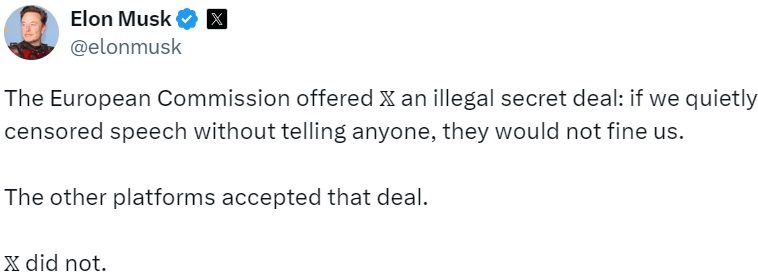
Musk’s statement was in response to an X post by Margrethe Vestager, Executive Vice President of the European Commission for a Europe fit for the Digital Age and Commissioner for Competition, regarding the EC’s findings of X’s noncompliance with the Digital Services Act (DSA). “In our view, X doesn’t comply with the DSA in key transparency areas. It misleads users, fails to provide adequate ad repository and blocks access to data for researchers. It’s the first time we issue preliminary findings under the Digital Services Act,” Vestager wrote.
The European Commission announced Friday that it had informed X of its preliminary view that the platform breached the Digital Services Act regarding dark patterns, advertising transparency, and data access for researchers.
The Commission found that X’s design for “verified accounts” misleads users by allowing anyone to obtain verification, potentially exploited by malicious actors. Additionally, X fails to provide a functional advertisement repository, which hampers transparency and research into online advertising risks. The platform also imposes high fees and cumbersome processes for researchers seeking API access to public data.
Thierry Breton, the Commissioner for Internal Market of the European Union, commented: “Back in the day, Bluechecks used to mean trustworthy sources of information. Now with X, our preliminary view is that they deceive users and infringe the DSA. We also consider that X’s ads repository and conditions for data access by researchers are not in line with the DSA transparency requirements.” He added: “X has now the right of defense — but if our view is confirmed we will impose fines and require significant changes.”
The announcement explains that if the EC’s view is confirmed:
Such a decision could entail fines of up to 6% of the total worldwide annual turnover of the provider, and order the provider to take measures to address the breach.
X has the opportunity to respond to these findings before any final decision. This investigation is part of the EC’s broader efforts to enforce DSA compliance among social media platforms, including Tiktok, Aliexpress, and Meta.
What do you think about Elon Musk’s revelation of the censorship deal proposal and the EC’s findings regarding X? Let us know in the comments section below.