The stablecoin market has seen explosive growth in 2024, with total supply reaching $214 billion and transfer volume hitting $35 trillion, according to a new report by Dune Analytics and Artemis Terminal.
Dune Study Shows Stablecoin Supply Grew 63% in 2024, Reaching $225 Billion

This article was published more than a year ago. Some information may no longer be current.
WRITTEN BY

SHARE

Stablecoins in DeFi: $35 Trillion in Transfers Driven by Decentralized Finance
The stablecoin market has experienced significant growth in 2024, with total supply reaching $214 billion and transfer volume hitting $35 trillion, according to a report by Dune and Artemis. Stablecoins, which are pegged 1:1 to assets like the U.S. dollar, have become a critical bridge between traditional finance and the crypto economy, facilitating cross-border payments and enhancing liquidity in digital asset markets.
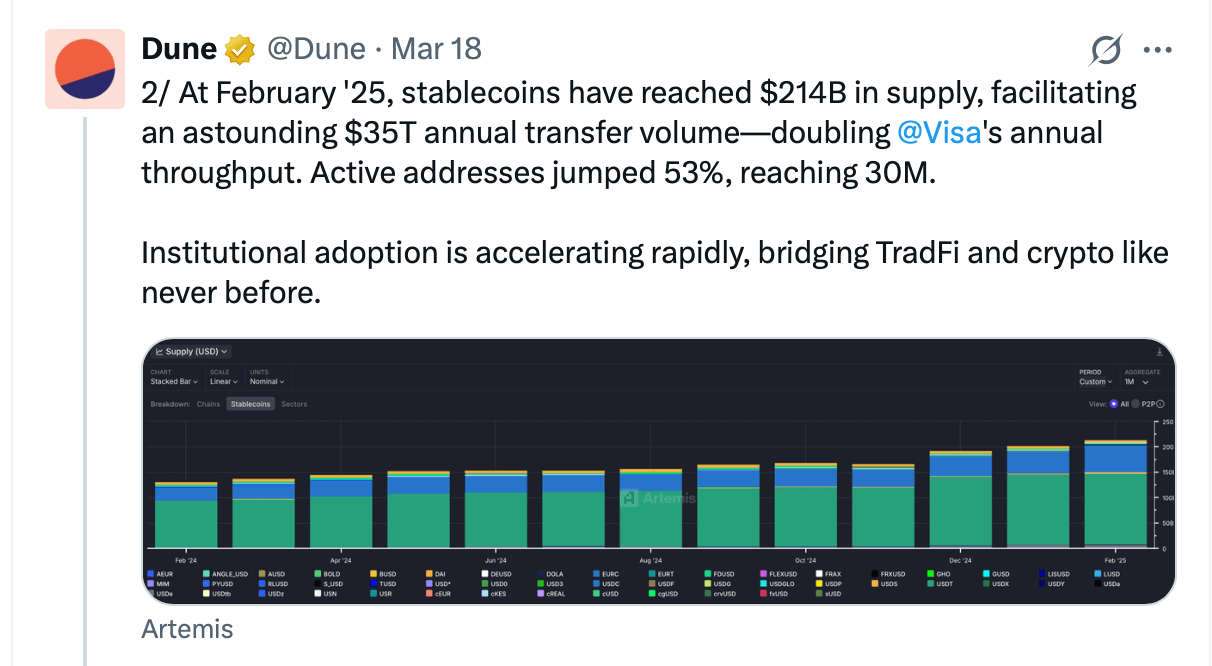
Institutional adoption has accelerated, with asset managers and payment providers increasingly integrating stablecoins into their operations. Despite this growth, stablecoins remain a fraction of traditional fiat liquidity, with the U.S. M1 money supply at $18.4 trillion. However, in transaction volume, stablecoins have surpassed major payment networks like Visa and Mastercard, processing $35 trillion in transfers compared to Visa’s $15.7 trillion and Mastercard’s $9 trillion in Q4 2024.
USDC has emerged as the leader in transfer volume, accounting for 66% of total stablecoin transfers, while USDT remains dominant in peer-to-peer transactions, particularly on the Tron network. Meanwhile, decentralized stablecoins like Ethena’s USDe have gained traction, with USDe’s market cap reaching $6.2 billion within a year of its launch.
Ethereum and Tron continue to dominate stablecoin activity, but Solana and Base have seen significant growth, driven by memecoin trading and DeFi activity. Base, in particular, has become a hub for regional stablecoins like EURC and BRZ, expanding financial inclusion by offering low-cost, on-chain alternatives for fiat transactions.
The report highlights the growing role of stablecoins in both decentralized and traditional finance, with DeFi applications driving the majority of transfer volume. As regulatory frameworks evolve, stablecoins are poised to play an even larger role in global financial infrastructure, according to the Dune and Artemis study.