


This content is provided by a sponsor.
DAPPOS Explained: The Web3 AI OS Redefining Web3 Intelligence
SHARE
Press release
PRESS RELEASE.
Artificial Intelligence (AI) has become the engine of modern productivity. Across design, research, and automation, AI now assists in everything from generating marketing visuals to building applications. Yet despite these advances, the Web3 ecosystem remains largely outside the reach of AI’s real potential.
The reason? Generic AIs are powerful, but their intelligence is horizontal, not contextual. They were trained on static internet text — not on dynamic systems like blockchains.
This leads to critical gaps across every Web3 workflow:
- Can’t access or interpret on-chain data or wallet-specific insights.
- Struggle to precisely understand and learn the latest crypto information under the web3 context.
- Lack of multiple productivity tools to streamline Web3 workflows.
- Illusion of social sentiment and crypto-native cues like meme trends or community signals.
- Fail to continuously Incentivize ecosystem contributors
This is where DAPPOS enters the picture: the AI Operating System for Web3. Rather than functioning as another analytic chatbot, DAPPOS is designed as an all-in-one AI operating system capable of understanding, reasoning, and acting within Web3 environments.
What is DAPPOS: The All-in-One AI Operating System for Web3
DAPPOS is an AI Operating System for Web3 productivity, backed by over $20M in funding from top investors like Polychain, Binance Labs, Sequoia. From image and video generation to vibe coding, deep research, and strategy design, DAPPOS serves as an all-in-one OS that powers Web3-specific AI applications in marketing, building, interacting, and trading.
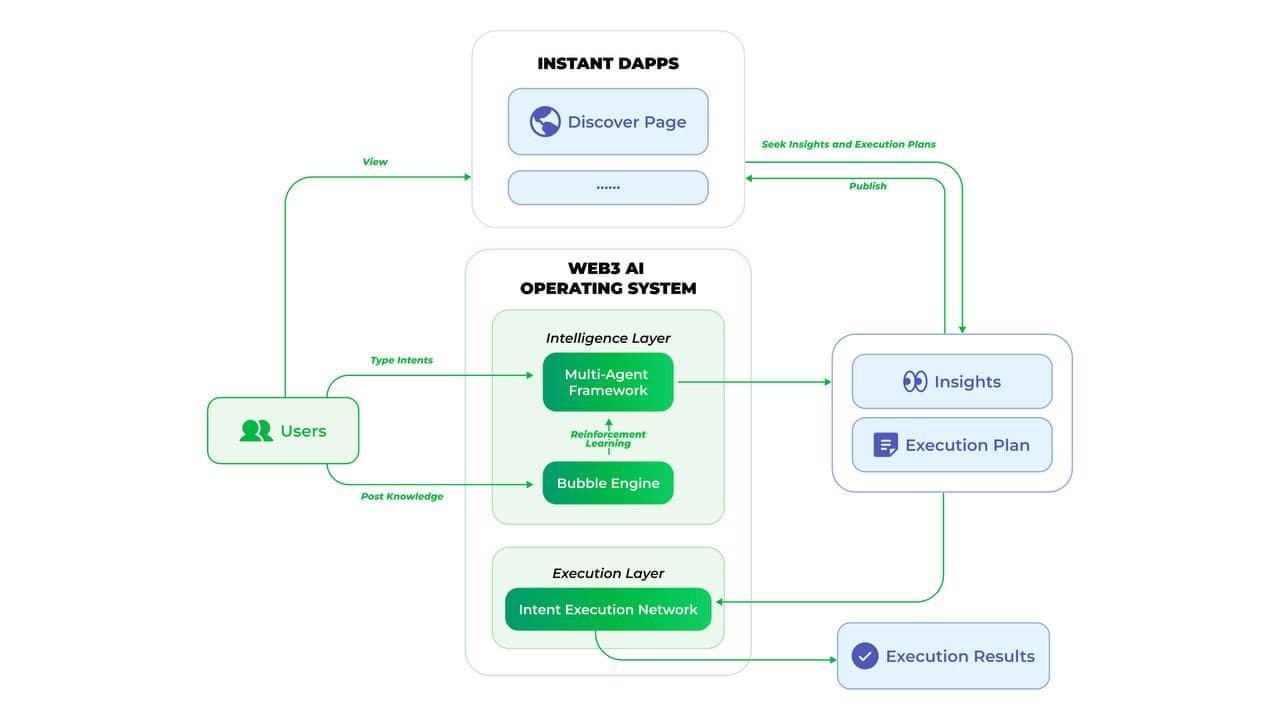
At its core, DAPPOS is structured as a two-layer architecture:
- Intelligence Layer – Multi-Agent Framework (MAF) & Bubble Engine
The Intelligence Layer of DAPPOS is powered by the Multi-Agent Framework (MAF), a scalable orchestration system featuring 300–400 specialized vertical agents and over 200 integrated tools. This setup enables domain-specific reasoning across diverse Web3 scenarios, from quantitative trading strategies to market sentiment analysis. Agents collaborate autonomously through a stateful graph backbone, routing tasks deterministically to subgraphs like Search (for real-time data aggregation), DeFi (for strategy generation and risk validation), and Opportunity (for alpha detection via on-chain and social signals).
Complementing MAF is the Bubble Engine, a continuous reinforcement learning (RL) system tailored for Web3. It ingests live insights from sources like X (formerly Twitter) and Binance Square, using contextual Retrieval-Augmented Generation (RAG) for provenance-first data handling and compound memory to blend durable knowledge with episodic learnings. This enables adaptive intelligence that evolves with the ecosystem, outperforming generic AIs in handling Web3 nuances, such as meme coin hype or deceptive practices.
- Execution Layer – Intent Execution Network
At the foundation of the Execution Layer is the Intent Execution Network, a distributed execution system that transforms AI-driven intentions into verifiable on-chain actions. Whether deploying a smart contract, running an airdrop campaign, or generating and executing a marketing strategy, DAPPOS ensures secure and efficient executions — bridging the gap between AI decisions and blockchain action.
Together, these layers create an AI-powered user journey all within a single, unified AI operating system:
What DAPPOS Means for Builders and Users
The practical implications of a Web3 AI OS extend far beyond pure analysis or automation. DAPPOS enables AI-native workflows, where creativity, reasoning, and execution coexist in one place.
Consider a scenario in Web3 marketing: an AI agent identifies an emerging narrative trend around meme coins. Within the same system, DAPPOS can generate on-brand visuals, craft promotional text, analyze social data to optimize timing, and create a website for the campaign — all executed in the AI OS.
In trading and investment contexts, DAPPOS agents can perform deep on-chain research, detect cross-chain arbitrage opportunities, and execute strategies programmatically — all while maintaining verifiable transparency. For developers, the system functions as an all-in-one AI studio capable of generating dApps, refining smart contracts, and automating user testing through natural language tasks.
Why DAPPOS Stands Out in the Web3 AI Landscape
While “AI integration” has become a common buzzword across Web3 projects, few systems have tackled the technical and infrastructural challenges of true AI-native operation. DAPPOS differentiates itself through four defining characteristics.
Multimodal Creation and Execution
DAPPOS supports multimodal workflows across text, code, image, video, and dApp logic. A user can research a narrative trend, generate a visual campaign, write an on-chain deployment script, and execute it — all within one AI-coordinated workspace. This multimodality transforms AI from a productivity aid into a full creative and operational layer for Web3.
Web3-Optimized Intelligence
Through the Bubble Engine’s reinforcement learning architecture, DAPPOS continuously refines its understanding of decentralized data. Instead of generic AI reasoning, it learns directly from blockchain-level events, tokenomics behaviors, and cross-protocol activity — providing insight that is natively optimized for Web3 decision-making.
Proven Infrastructure and Scalability
The DAPPOS Execution Network has already processed over 12 million on-chain operations across 5 million users, proving its scalability in live environments. This operational track record places it among the few AI systems with demonstrated reliability in decentralized execution.
Open Ecosystem and Incentive Alignment
DAPPOS is an open AI ecosystem. Developers can integrate their own agents through the SDK, while users are rewarded for contributing data, use cases, or successful AI outcomes. The incentive mechanism ensures that as the system grows, intelligence can evolve through collective participation.
Why It Matters for the Next Era of Web3
The next evolution of Web3 will not be defined by new chains or protocols, but by the emergence of AI-native Web3 — a paradigm where intelligence, execution, and value flow are seamlessly integrated. In this model, AI is no longer an auxiliary tool that assists users from the sidelines; it becomes the core operating system that drives decision-making, coordination, and action across decentralized environments.
This transformation reshapes the collaboration between humans, AI, and blockchain. Tasks that once required manual analysis, planning, and execution can now occur through autonomous, verifiable intelligence loops. Every action — from research to contract deployment — becomes part of a living, learning system where AI both interprets and interacts with the on-chain world in real time. The implications are revolutionary.
DAPPOS stands at the forefront of this shift. By fusing reasoning, context awareness, and on-chain execution into one AI operating system, it transforms Web3 from a collection of blockchain networks into an intelligent ecosystem. DAPPOS is not just participating in the AI-native Web3 movement — it is defining its architecture and leading its momentum.
_________________________________________________________________________
Bitcoin.com accepts no responsibility or liability, and is not responsible, directly or indirectly, for any damage or loss caused or alleged to be caused by or in connection with the use of or reliance on any content, goods or services mentioned in the article.