Both the U.S. and international crude benchmarks, WTI and Brent futures, surpassed $100 on Sunday night as the market examined the effects of a possible attack on Iran’s Kharg Island oil facilities, considered a hub for 90% of the nation’s oil exports.
Crude Prices Rise Over $100 as Trump Mulls Attacking Iran's Kharg Island Oil Facilities
WRITTEN BY

SHARE
Oil Prices Continue to Rise as Trump Takes Aim at Kharg Island
The ongoing conflict between the U.S.-Israel coalition and the Iranian regime continues to disrupt energy prices.
Oil markets continue to feel the pressure of an escalation that could destroy the oil facilities located on Kharg Island, an Iranian oil hub that handles 90% of Iran’s crude exports.
Both West Texas Intermediate (WTI) and Brent Futures rose above $100 on Sunday night, with the latter reaching over $104 per barrel, signaling a lack of confidence in a normalization of the oil market and the reopening of the Hormuz Strait.
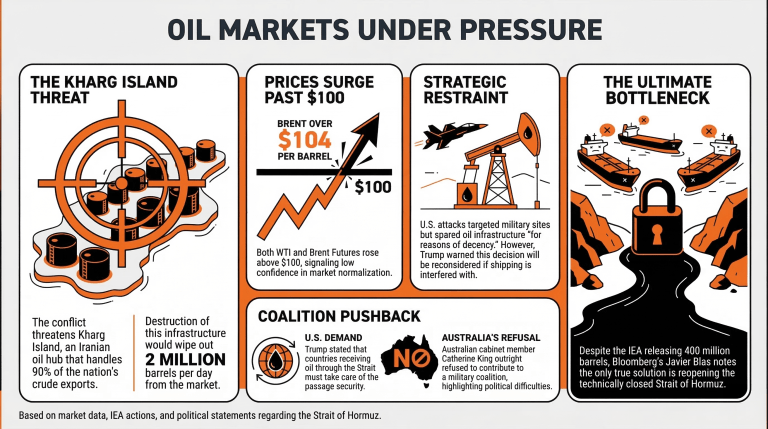
While Trump directed attacks on so-called “military targets in the island,” he did not attack the oil infrastructure “for reasons of decency”. Nonetheless, he also stated that “should Iran, or anyone else, do anything to interfere with the Free and Safe Passage of Ships through the Strait of Hormuz, I will immediately reconsider this decision.”
The destruction of this infrastructure would wipe out 2 million barrels per day from the market until the conflict ends, further impacting prices. While the International Energy Agency (IEA) has coordinated the release of 400 million barrels of oil into international markets, Bloomberg’s commodity expert Javier Blas points out that “ultimately, only one thing solves the problem: re-open the Strait of Hormuz.”
The Strait of Hormuz remains technically closed, as the Trump Administration has not yet devised a way to secure the safe passage of tankers. The President has stated now that “Countries of the World that receive Oil through the Hormuz Strait must take care of that passage” with the help of the U.S.
Establishing a coalition to this end is seen as politically difficult, as it might be considered an intervention in the military conflict by the country integrating it. Catherine King, a member of the Australian cabinet, has outright refused the idea of contributing in this way, stressing that they knew “how incredibly important that is, but that’s not something that we’ve been asked or that we’re contributing to.”

Oil Markets Brace as Trump Calls Allied Navies to Defend Hormuz Passage
President Donald Trump said Saturday that the United States and allied nations are preparing to send warships to the Strait…
Read Now

Oil Markets Brace as Trump Calls Allied Navies to Defend Hormuz Passage
President Donald Trump said Saturday that the United States and allied nations are preparing to send warships to the Strait…
Read NowOil Markets Brace as Trump Calls Allied Navies to Defend Hormuz Passage
Read NowPresident Donald Trump said Saturday that the United States and allied nations are preparing to send warships to the Strait…
FAQ
- How is the ongoing U.S.-Israel conflict affecting oil prices?
The conflict has caused oil prices to rise, with Brent Futures exceeding $104 per barrel due to concerns over potential damage to Iranian oil facilities. - What impact would the destruction of oil infrastructure on Kharg Island have?
Destroying Kharg Island’s infrastructure could remove 2 million barrels per day from the market, significantly worsening price volatility. - What measures is the International Energy Agency taking in response to rising oil prices?
The IEA has coordinated the release of 400 million barrels of oil into international markets to alleviate supply pressures. - What challenges are there in securing the Strait of Hormuz for oil passage?
The Trump Administration faces political difficulties in forming a coalition for safeguarding tanker routes, as countries are hesitant to intervene in the military conflict.