Craig Wright, the Australian computer scientist claiming to be Satoshi Nakamoto, faced a rigorous week-long cross-examination. The proceedings, which unfolded in the U.K. High Court, saw Wright defending his assertion against the Crypto Open Patent Alliance (COPA) and a coalition of Bitcoin developers, raising serious doubts about his narrative.
Craig Wright's Satoshi Claims Challenged in Intense UK Court Cross-Examination

This article was published more than a year ago. Some information may no longer be current.
WRITTEN BY

SHARE
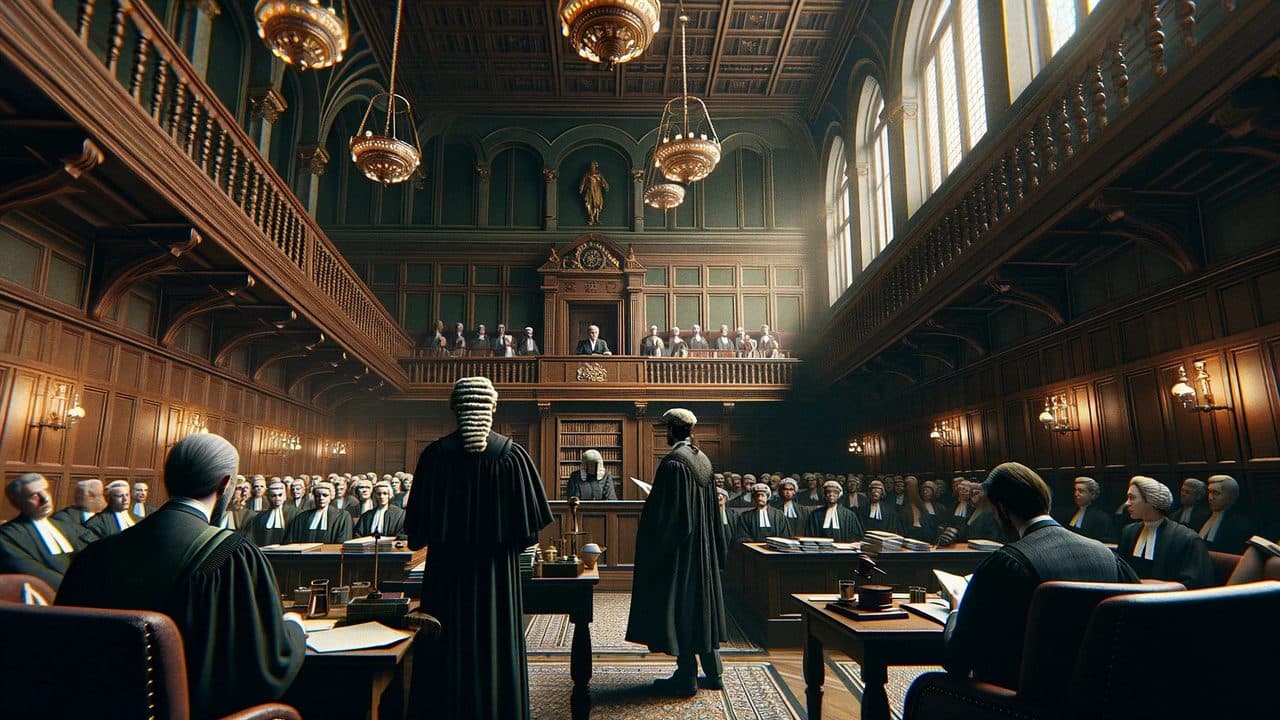
Craig Wright’s Battle to Prove He Invented Bitcoin Faces 30 Hours of Questions in Court
The intense cross-examination of Craig Wright, the Australian computer scientist who claims to have invented Bitcoin under the pseudonym Satoshi Nakamoto, concluded Wednesday.
Wright, who has been embroiled in legal battles over his assertion since 2016, faced questions over seven days lasting more than thirty hours in the U.K. High Court by COPA and a group of Bitcoin developers. The cross-examination aimed to scrutinize Wright’s claims and his connections to Bitcoin’s creation in 2008.
Observers noted that the cross-examination exposed significant challenges in Wright’s narrative. Jason Deane, commenting on the day’s proceedings on social media, highlighted a series of “gotchas” that he believes could potentially derail Wright’s case unless there is a dramatic turn of events. Wright struggled to provide coherent explanations for discrepancies in his story, including denying signatures, contracts, and email threads he was allegedly part of, and showing a lack of understanding of key parts of what he claims is his code.
For example, Wright seemed unable to explain what an unsigned variable is in C++ when asked:
[Wright]: Basically an unsigned variable, it’s not an integer with … it’s larger, I’m not sure how to say it.
[Gunning]: Try.
[Wright]: How I’d describe it, I’m not quite sure. I’m not good with trying to do things like this.
[Gunning]: You said you had a book by Professor [something] You have disclosed C++ book. You see it explains that unsigned means it cannot be negative.
[Wright]: Yes, I know *that*. But I don’t know how to say it so simply.
Wright tried to dismiss cryptographic proof as adequate evidence of his role as Satoshi, instead favoring citing thousands of unrelated patents and the absence of other claimants as sufficient evidence:
[COPA]: Without [witnesses, documents], there’s no proof.
[Wright]: I have […] 1300 in-progress patents, 4000 pending, that in itself is evidence. Early people like Gwern tried to [missed]. Maxwell outed someone falsely because of one patent, Back too. All of them denied it. Despite all of this, no Satoshi has come forth. 20 years from now, there still won’t be. If I lose this case, I will create more patents…
The trial has become a spectacle not just for its legal implications but also for the portrayal of Wright’s character and his vision for Bitcoin. Wright’s assertion of wanting to centralize and manage Bitcoin under his supervision was met with disbelief by many in the cryptocurrency community.
Jonathan Hough, representing COPA, pressed Wright on alleged anomalies and forgeries in the evidence supporting his claim to be Nakamoto. Occasionally Hough spoke with biting candor. On day 3 Hough said, “You’re simply saying black is white.” On day 9 he concluded his cross-examination with:
[COPA]: You are not the author of Bitcoin wp or source code.
[Wright]: I am the person who invented Bitcoin, the hash-chain system, timestamp server. Over 1000 patents, 4000 pending…
[COPA]: It’s a lie and a hoax.
[Wright]: The opposite. We are spending millions of pounds per month testing scaling…
[COPA]: It’s a lie you have supported with the forged documents.
[Wright]: No.
[COPA]: A lie that has sustained other lies.
[Wright]: No, it is not.
[COPA]: My Lord, no further questions.
Wright’s witnesses, set to take the stand following his testimony, are expected to support his claims about discussing digital currency concepts before Bitcoin’s launch. However, the veracity of Wright’s narrative and the authenticity of his evidence remain contentious points.
Do you think Wright was convincing in the length cross-examination? Share your thoughts and opinions about this subject in the comments section below.