


Circle’s stock rebounded 7% on Monday following a 17% plummet the previous Tuesday, triggered by the announcement of a rival stablecoin, Open USD.
Circle Climbs 7% After $64 Open, but OUSD Keeps Pressure on Its Yield Strategy
WRITTEN BY

SHARE
Key Takeaways
- Circle stock rebounded 7% Monday after an OUSD press release previously triggered a 17% session drop.
- OUSD threatens Circle’s business model, where 96% of revenue relies on keeping interest on reserves.
- Regulators will release final rules on July 18, determining if OUSD can legally pay yield by 2027.
The Battle for Reserve Yield
The stock of Circle, the issuer of the USDC stablecoin, jumped 7% on Monday as investor panic following the announcement of the launch of rival coin Open USD subsided. According to market data, CRCL topped $69.52 at around 3:30 p.m. EST, after starting the day trading just over $64. Nevertheless, at the time, the stock was still more than 5% below its June 29 opening price of $75 and well below its year-to-date peak of more than $132 recorded around March 18.
The stock’s volatility follows a turbulent session last Tuesday, when a single press release caused Circle’s stock to plummet 17% in one day. A consortium of more than 140 companies—including Visa, Mastercard, Stripe, Google, and Blackrock—announced the development of Open USD (OUSD). Led by Zach Abrams, the project is seen as directly targeting Circle’s core business model.
According to one analyst, approximately 96% of Circle’s revenue is derived from reserve interest earned on the cash and Treasuries backing USDC. Unlike Circle, which retains nearly all of this yield, Open USD reportedly plans to eliminate minting and redemption fees and route nearly all reserve income back to the partners driving transaction volume. Critics note the announcement creates immediate head-to-head pressure for Circle’s market niche, particularly regarding its relationship with Coinbase.
Coinbase, Circle’s primary distribution partner, earned roughly $908 million in 2024 through a revenue-sharing agreement that is up for renewal in August 2026. By joining the Open USD consortium ahead of renegotiations, Coinbase has significantly increased its leverage. Furthermore, the threat highlights a broader industry shift: the highly profitable “float” on stablecoin reserves is now openly contested, exposing Circle’s reliance on interest margins.
Still, Open USD faces significant regulatory headwinds that have yet to be fully priced in by the market, according to Defi research educator Dolak1ng. He asserts that the GENIUS Act bans stablecoin issuers from paying yield to holders, and a February proposal from the Office of the Comptroller of the Currency (OCC) seeks to extend that ban to yield routed through third parties. So while Open USD’s parent company, Open Standard, plans to argue the model fits a carve-out for non-affiliated partners, the legality of the structure remains unclear.
Infrastructure as a Strategic Hedge
Meanwhile, Open USD’s ability to lure some of the largest payment providers and financial technology firms may indicate that the next phase of stablecoin growth is being shaped not only by crypto-native issuers, but by non-crypto entities as well. This market evolution raises the broader question of who will ultimately control the next generation of digital dollar infrastructure: crypto-native players, traditional financial institutions, global payment networks, or technology platforms commanding massive distribution networks.
Ozan Ozerk, founder of Openpayd, noted that infrastructure remains the ultimate hedge against this shift. “You don’t need to pick the winning stablecoin if you’re the layer that holds and moves all of them,” Ozerk told Bitcoin.com News. “Fragmentation isn’t a threat to infrastructure — it’s the reason infrastructure matters. As reserve economics shift toward the businesses moving these balances, neutral orchestration becomes the durable position, whichever coin comes out on top.”
MinChi Park, COO and co-founder of Coinfello, added that a consortium stablecoin backed by payment networks and asset managers is less about a new currency and more about a new settlement rail.
“For platforms like ours that let AI agents execute onchain, that matters more than market share,” Park said. “Agents need deterministic settlement, deep liquidity on the chains they operate on, and issuers that treat programmability as a feature, not an afterthought. Fragmentation across issuers is fine. Fragmentation across trust models is not.”
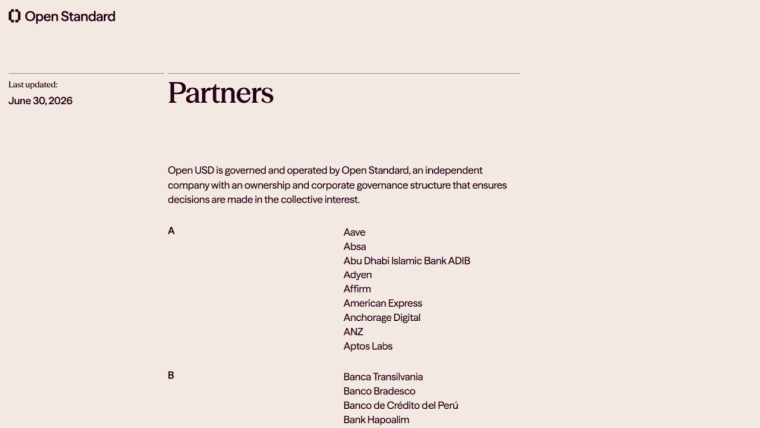
Some companies that appeared to be listed in the Open USD Consortium have refused to approve their inclusion. Blockmedia's BD…
Read Now: Open USD Backlash: Consortium Faces Allegations of Faking Key Stablecoin Partnerships