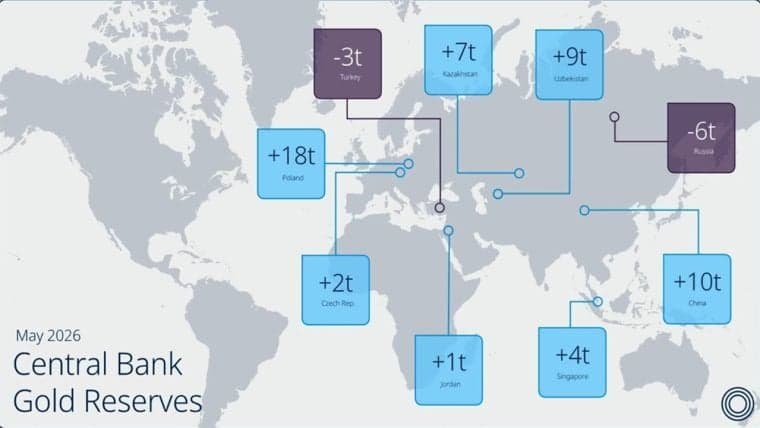
World Gold Council data sourced from official central bank reports found that while H1 2026 demand (345 tonnes) was the lowest since 2022, accumulation accelerated in Q2, with institutions netting purchases of 288.9 tonnes. Poland, Uzbekistan and China pushed demand, while Russia and Turkey were net sellers.
Central Bank Gold Purchases Jump 62% to 288.9 Tonnes in Q2
WRITTEN BY

SHARE
Key Takeaways
- Central bank gold demand hit a Q2 record of 289 tonnes, rebounding sharply from a weak Q1.
- Poland led purchases to near its 700-tonne goal, while China accelerated buying and Russia sold.
- Most central banks plan to continue adding gold to their reserves to hedge against geopolitical risks.
Central Bank Gold Demand Picks Up During Q2, Institutional Purchases Reach 288.9t
After weak Q1 numbers, institutions have registered a rise in gold purchases in Q2, reaching a period record.
The World Gold Council (WGC) found that central bank demand rebounded sharply in Q2 2026, with net purchases reaching 288.9 tonnes, a 62% increase compared to the same period in 2025 (177.9 tonnes).
This also represents a sharp increase compared to revised numbers from Q1, when net accumulation slowed down to 57 tonnes. This recovery had two main drivers: an increase in purchases from the Central Bank of Poland and the People’s Bank of China, and a slowdown in sales from Turkey and Russia.
Even so, overall central bank gold demand fell to the lowest since 2022, registering only 345t due to hefty sales from Turkey, Russia and Azerbaijan.
The largest buyer in Q2 was, as expected, the National Bank of Poland, which has a self-established goal of reaching 700 tonnes for its national reserves. The bank acquired 51 tonnes, which, together with the 31 tonnes purchased in Q1, account for the 82 tonnes brought home by the institution during H1.
The People’s Bank of China also registered an increased interest in gold, purchasing the most since Q4 2023, with its reported reserves reaching 2,346 tonnes. Nevertheless, several reports indicate that China is covertly accumulating gold through London imports that go undeclared as the country shifts from dollars to gold. This is consistent with WGC findings, which determined that undeclared gold purchases were elevated.
Uzbekistan, with 16 tonnes; Kazakhstan, with 15 tonnes; the Central Bank of Jordan, with 6 tonnes, and the Czech Republic, with 6 tonnes, also contributed to the record demand in Q2.
In contrast, the Bank of Russia registered the most gold sold in Q2, with 22 tonnes, as reports indicate it seeks to plug its federal budget deficit. Turkey, the largest seller in Q1, slowed its unloading, accounting for 4 tonnes in this period.
WGC’s own Central Bank Gold Reserves Survey anticipates that gold purchases will continue to gain momentum later this year, with 89% of central bankers expecting gold reserves to increase in the next 12 months.