


Despite a positive global market response to a newly announced U.S.-Iran memorandum of understanding, bitcoin experienced high volatility and a 1.4% price decline, dropping to an intraday low of $65,301 before stabilizing near $65,919.
BTC Holds Above $65,500 as Santiment Signals Bitcoin Could Gain From US-Iran MoU

This article was published more than a month ago. Some information may no longer be current.
WRITTEN BY

SHARE
Key Takeaways
- Bitcoin fell to a $65,301 intraday low on Tuesday despite a U.S.-Iran MoU lifting traditional markets.
- The crypto downturn erased 1.4% of market value, sparking $81 million in derivatives liquidations.
- Santiment predicts the geopolitical truce will eventually rotate global capital back into Bitcoin.
Global Markets Diverge as Oil Slides
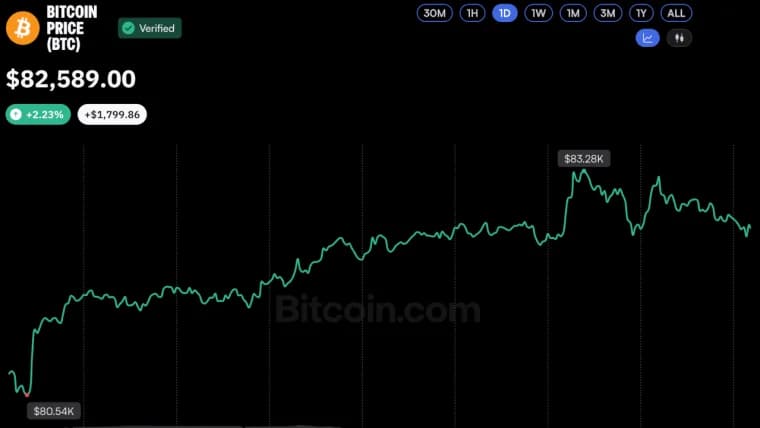
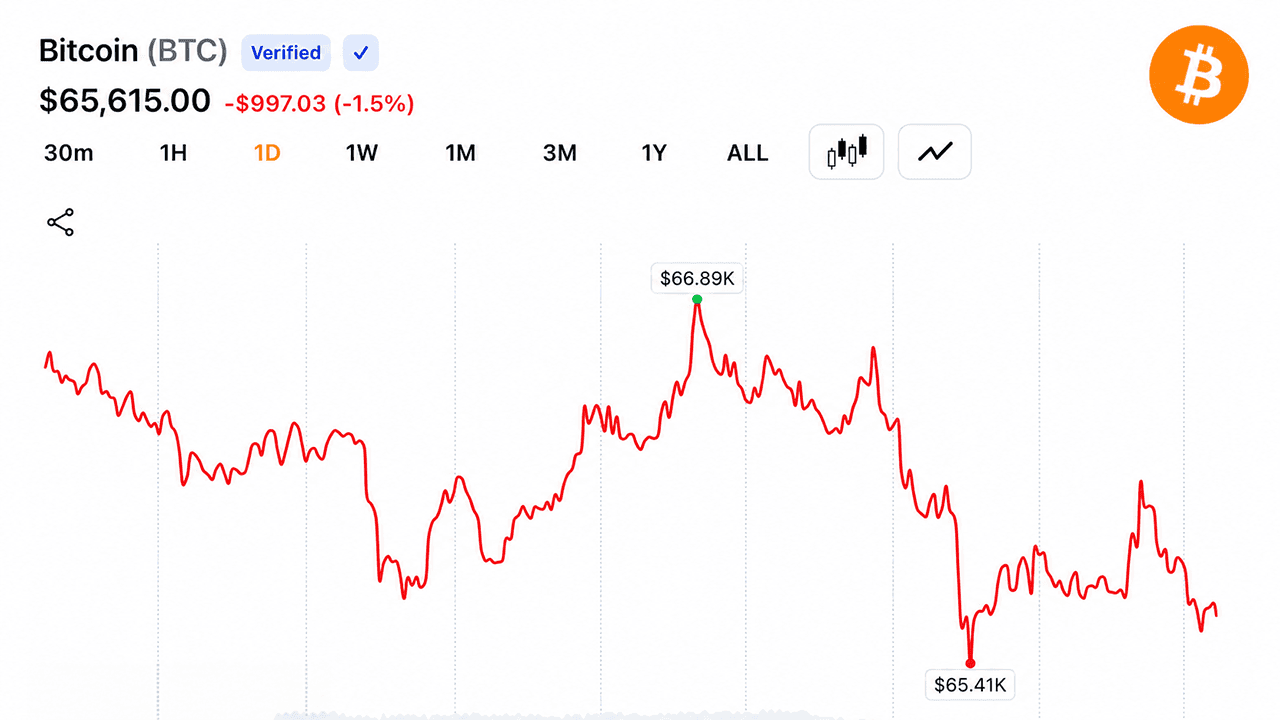
Bitcoin traded down on Tuesday even as global markets continued to respond positively to the announcement of a U.S.-Iran memorandum of understanding. The daily chart shows that shortly after breaching $67,000, bitcoin trended downward until it reached just under $65,700. The cryptocurrency then rallied and nearly tested the $67,000 threshold, but the surge was short-lived as the price plummeted to an intraday low of $65,301.
At the time of writing (2:30 p.m. EST), bitcoin was trading just under $65,919 after a second rally hit a brick wall shortly after reaching $66,148. With this retreat, bitcoin shed approximately 1.4% in value, dragging its market capitalization down to $1.32 trillion. The price action also triggered the liquidation of $61 million in long bets and nearly $20 million in shorts within a 24-hour window.
The top cryptocurrency’s performance mirrored that of the wider digital asset economy, whose market capitalization also declined 1.4%. In contrast, Asian and European equity indices, which surged on the MoU announcement, traded sideways, with South Korea’s Kospi being the only index with gains exceeding 1%. Meanwhile, global oil prices continued to slide, with Brent crude falling below $80 per barrel, its lowest level in weeks.
Although details of the MoU remain murky, President Donald Trump and senior administration officials voiced optimism that the agreement will end the conflict and result in the resumption of normal traffic in the Strait of Hormuz. Opening the strait will allow shipping vessels stuck in the Persian Gulf to finally move oil to global markets, a move that could potentially lead to even lower prices.
Despite the immediate volatility, blockchain analytics firm Santiment argued the MoU could function as a long-term catalyst rather than a short-lived sentiment bump. The firm noted that periods of geopolitical stabilization historically coincide with reduced risk premiums, triggering systematic reallocations from defensive assets into riskier investments.
Under this framework, bitcoin often acts as the primary recipient of returning liquidity because of its deep derivatives markets, global accessibility, and sensitivity to macroeconomic shifts in investor risk appetite. Santiment suggested that if geopolitical relief persists, the resulting capital rotation could support a more durable bull market rather than a transient price reaction.
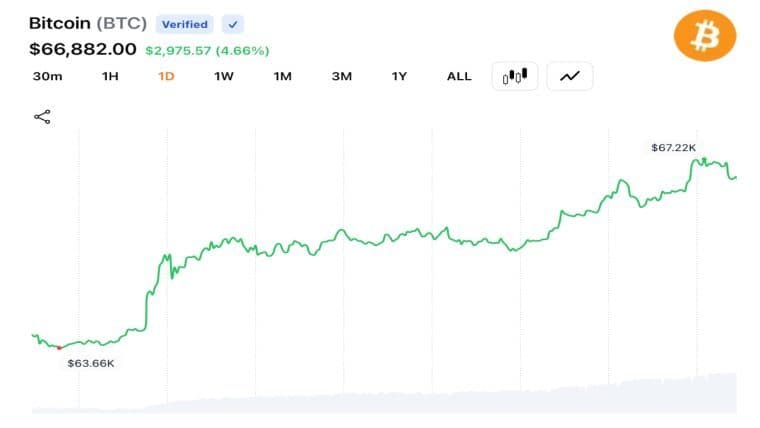
A geopolitical breakthrough between the U.S. and Iran has triggered a massive global market relief rally, headlined by bitcoin rebounding…
Read Now: Bitcoin Jumps Above $67,000 as US-Iran Deal Triggers $198M Short Liquidations