A measure would seek to smooth things over in Congress as President Luiz Inácio Lula da Silva shifts gears in anticipation of the upcoming elections. Dario Durigan, the recently confirmed Economy Minister, will focus on other issues to avoid losing further support from lawmakers.
Brazil Backpedals on Crypto Taxation as Presidential Election Looms
WRITTEN BY

SHARE

Crypto Taxation Plans Delayed as Lula Shifts Into Election Mode
While local media reported that taxation of stablecoin transactions in Brazil was just weeks away, new data indicate that the government has shifted its action to other priorities.
According to sources consulted by Reuters, the Brazilian government will delay these measures for a hypothetical upcoming fourth term for President Luiz Inácio Lula da Silva as the government shifts into full election mode and avoids issuing controversial legislation.
“It remains on the radar. But it needs to be handled carefully, because tempers are running high in Brasilia,” a source stressed.
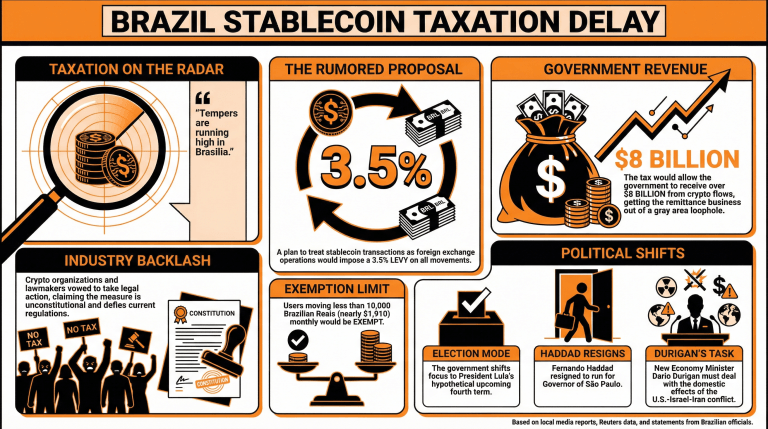
The move comes after a rumored taxation plan that treats stablecoin transactions as foreign exchange operations would impose a 3.5% levy on all movements, including exemptions for users who don’t move over 10,000 Brazilian reais (nearly $1,910) monthly.
The proposal faced immense backlash from crypto organizations and lawmakers, who even vowed to take legal action against this measure, claiming it would be unconstitutional and defy current cryptocurrency regulation.
According to analysts, while this proposal would upset the cryptocurrency industry in the country, it would also allow the government to receive over $8 billion from crypto flows, getting the stablecoin remittance business out of a gray area. Currently, Brazilians leverage this so-called loophole to avoid being taxed.
The newly confirmed Economy Minister, Dario Durigan, who coincidentally reinforced that stablecoin taxation rules were in the works back in November, is the new face of the economy and must deal with the effects of the U.S.-Israel-Iran conflict on Brazil’s financials.
Durigan steps in after Lula’s longtime ally, Fernando Haddad, resigned to also participate in the upcoming elections, seeking to be elected Governor of São Paulo.

Brazil to Propose 3.5% Tax on Stablecoin Purchases and Remittances
The measure, described last week, would be submitted by Brazil's Revenue Service for public consultation and would impose a 3.5%…
Read Now

Brazil to Propose 3.5% Tax on Stablecoin Purchases and Remittances
The measure, described last week, would be submitted by Brazil's Revenue Service for public consultation and would impose a 3.5%…
Read NowBrazil to Propose 3.5% Tax on Stablecoin Purchases and Remittances
Read NowThe measure, described last week, would be submitted by Brazil's Revenue Service for public consultation and would impose a 3.5%…
FAQ
-
Why is Brazil delaying its proposed tax on stablecoins? The government is postponing the controversial measure until after the upcoming elections to avoid political backlash.
-
What did the rumored Brazilian crypto tax entail? The proposed plan would impose a 3.5% levy on stablecoin transactions by treating them as foreign exchange operations.
-
How did local organizations react to the stablecoin tax? Brazilian lawmakers and crypto groups threatened legal action, arguing the measure was unconstitutional and defied current regulations.
-
Who is now overseeing Brazil’s economic and crypto policies? Newly confirmed Economy Minister Dario Durigan has assumed control after Fernando Haddad resigned to run for Governor of São Paulo.