


“I think we will have a lot less retail, and it’ll be more of the institution and more of the business meeting environment,” FactBlock CEO Andrew Park told Bitcoin.com News ahead of KBW2026.
SPONSORED CONTENT
This article was written by Bitcoin.com News on behalf of KBW2026. This is sponsored content produced by the Bitcoin.com News editorial team.
FactBlock’s Institutional Shift Takes Shape at KBW2026
SHARE
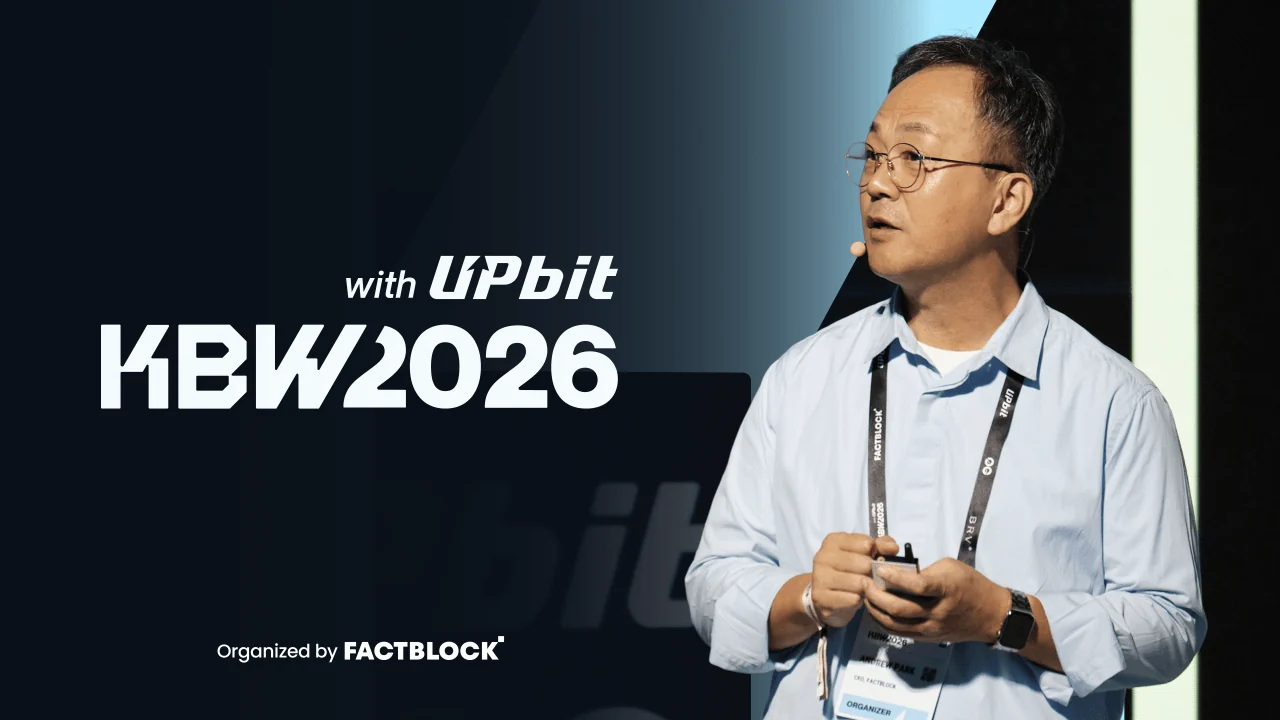
By the time the conference closed in Seoul on Oct. 1, there was evidence supporting that prediction. Of the 290 speakers at the main conference, 115, or 39.7%, represented finance, policy, digital asset investment and related services, according to figures released by FactBlock. A newly introduced institutional summit had also brought U.S. policy officials, Asian regulators and financial-sector executives together before the wider conference began.
Park had outlined the strategy during a pre-event interview with Bitcoin.com News’ David Sencil. FactBlock, the organizer of KBW since 2018, wanted to bring traditional finance and the digital asset industry closer together through an expanded conference format, a new partnership with Upbit and greater emphasis on business relationships.
Drawing on more than three decades in financial services, including roles at Chase, Samsung Card, American Express and Visa, Park viewed blockchain as the next evolution of financial infrastructure. KBW2026 was an opportunity to bring the institutions and companies involved in that transition into the same room.
A Different Mix at Walkerhill
“Less of the developers; it’s more of the institutions,” Park told Bitcoin.com News when discussing the intended shift.
He described the previous edition as more heavily focused on retail participants and crypto projects. For 2026, FactBlock had deliberately sought more representatives from financial institutions, particularly from the United States and Europe, while maintaining the event’s established presence among blockchain founders and developers.
The finished conference reflected that direction. Across Sept. 30 and Oct. 1, KBW recorded 12,500 in total attendance, with 290 speakers delivering 120 sessions across three stages, according to Financial News.
Institutional partners included Korea Investment & Securities, Samsung Securities, Kyobo Life Insurance, Hyundai Card, Korea Investors Service and EY Hanyoung.
The discussions also reflected the change in participation. Representatives from Moody’s, S&P Global and Franklin Templeton examined the information and valuation frameworks needed for institutional digital asset investment. Mirae Asset Global Investments discussed connecting traditional fund managers with real-world asset (RWA) tokenization infrastructure, while Japan’s SBI Group participated in a session examining how tokenization could advance beyond pilot projects.
These were established financial organizations discussing practical applications alongside crypto-native companies.
KBW nevertheless retained its broader industry character. Arthur Hayes, Joseph Lubin and other prominent crypto figures remained part of the program, alongside developers, exchanges and infrastructure providers. Institutional participation had become a substantial part of the conference without replacing its existing audience.
Upbit Gives the Expanded Format a Purpose
One of Park’s clearest pre-event commitments concerned the addition of a third day.
The 2025 main conference ran for two days. In 2026, FactBlock added the invitation-only Upbit Institutional Summit on Sept. 29, followed by the main conference on Sept. 30 and Oct. 1 at Walkerhill Hotels & Resorts.
Park described the opening day as a smaller gathering of influential decision-makers, with discussions covering policy, RWAs, security token offerings, stablecoins and the future of financial markets.
The summit delivered the senior-level participation FactBlock had sought.
According to Yonhap News Agency, speakers included Patrick Witt, executive director of the White House President’s Council of Advisers for Digital Assets, and Jonathan Hurowitz, a special adviser at the U.S. Treasury’s Office of Digital Asset Policy. Regulatory representatives from Asian countries and executives from the financial and digital asset industries also participated.
Sessions explored U.S. digital asset policy, tokenization, institutional market access, on-chain finance and the integration of artificial intelligence with blockchain technology.
The closed format allowed FactBlock and Upbit to concentrate those discussions into a dedicated gathering before the broader crypto audience arrived. The main conference subsequently brought institutional and crypto-native participants together through shared programming and networking.
Upbit’s involvement extended beyond the summit. As KBW2026’s presenting partner, the exchange maintained a presence throughout the main event. Its operator, Dunamu, introduced an Upbit Zone and GIWA Accelerator Showcase featuring projects across DeFi, RWAs, digital identity, AI and Web3.
The three-day structure therefore operated broadly as Park had described: an institutional opening followed by two days of wider industry participation.
Korea’s Regulatory Questions Remain Unresolved
Regulation was another area where Park had anticipated significant developments.
During the interview, he expressed hope that Korean lawmakers would announce progress on digital asset legislation shortly before KBW, giving the conference a timely policy development to discuss.
Instead, the event unfolded amid continuing uncertainty over South Korea’s regulatory framework.
On Sept. 30, Democratic Party lawmaker Min Byung-duk addressed the delayed Digital Asset Basic Act during KBW. According to Asia Business Daily, Min criticized the prolonged debate over stablecoin issuers and ownership restrictions on cryptocurrency exchanges. A scheduled public hearing had also been postponed.
The country’s cryptocurrency tax regime faced renewed scrutiny around the same time.
Under existing legislation, South Korea is scheduled to begin taxing virtual asset income on Jan. 1, 2027. However, lawmakers and industry representatives continued calling for another postponement, citing unresolved implementation concerns.
As reported by The Korea Times, Min supported delaying taxation until the Digital Asset Basic Act was established, while Finance Minister Lee Hyoung-il defended implementation under the existing timetable.
KBW’s institutional discussions therefore took place against a regulatory backdrop that remained unsettled. Stablecoins, tokenized assets and financial infrastructure received substantial attention, although the legislative clarity Park had hoped for was still lacking.
The Test That Continues After KBW
Park’s prediction of a more institutional KBW was supported by the speaker composition, the organizations represented and the dedicated Upbit summit. However, the available figures do not establish precisely how much retail attendance declined.
FactBlock’s 39.7% figure measures speaker affiliations across several sectors, including digital asset investment and services. Although KBW reported more than 14,000 attendees in 2025, the available attendance figures do not distinguish between retail and institutional participants. The extent of the shift in the broader audience therefore remains difficult to quantify.
There is also the question of what comes out of the meetings.
“The biggest success that I’m hoping for is the continuation after KBW,” Park told Bitcoin.com News before the event.
He explained that FactBlock intended to follow up on business-to-business discussions and track how many partnerships and collaborations eventually became active in Korea and elsewhere in the Asia-Pacific region.
The conference provided opportunities for those relationships to begin. Its institutional summit attracted senior decision-makers, established financial companies participated throughout the main program, and discussions increasingly addressed the commercial and regulatory requirements of digital asset adoption.
Park described KBW as “a marketplace,” bringing different participants together while allowing companies to determine where cooperation made commercial sense.
The 2026 edition demonstrated FactBlock’s ability to convene that mix of participants. The longer-term assessment now rests on the partnerships, financial products and business relationships that emerge from those meetings, the outcomes Park said FactBlock intends to follow well beyond the event itself.
_________________________________________________________________________
Bitcoin.com accepts no responsibility or liability, and shall not be liable, whether directly or indirectly, for any loss, damage, claim, cost, or expense of any kind, whether actual, alleged, or consequential, arising out of or in connection with the use of, or reliance upon, any content, goods, or services referenced in this article. Any reliance placed on such information is strictly at the reader’s own risk.