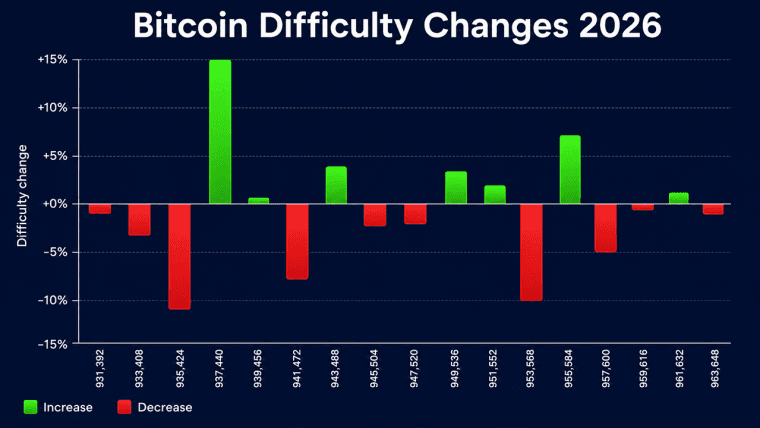



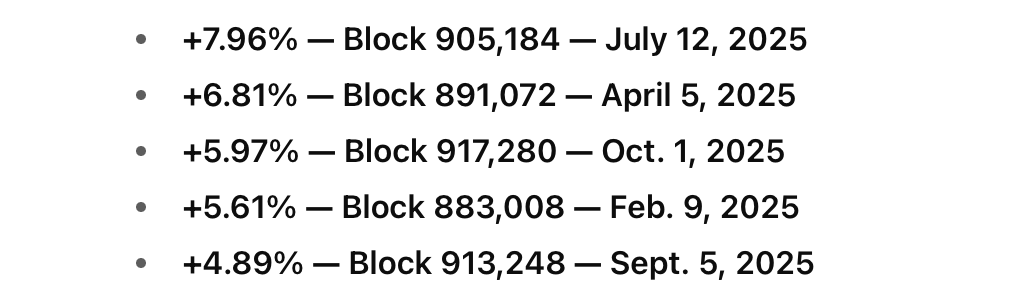
By the numbers, Bitcoin’s network difficulty climbed 5.97% at block height 917,280, landing it the title of this year’s third-biggest jump.
Bitcoin’s Dice Roll Just Got Tougher: Difficulty Climbs 5.97% in Third-Biggest Jump of 2025

This article was published more than a year ago. Some information may no longer be current.
WRITTEN BY

SHARE

Bitcoin Mining Odds Tighten
Finding a block just got a whole lot tougher—network difficulty jumped 5.97%, landing at 150.84 trillion.
Think of Bitcoin’s network difficulty like the odds of winning a colossal dice-toss lottery that resets every 10 minutes. Back in January 2009, when difficulty sat at 1, the target was practically wide open—miners needed only a handful of tosses to strike digital gold.
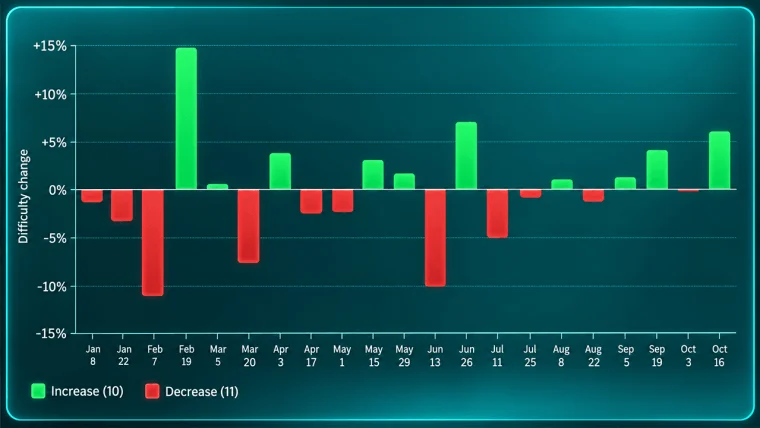
Fast-forward to today: with difficulty at 150.84 trillion, miners must now churn through, on average, 150.84 trillion times more dice rolls than in those early days to land a winning block. Every 2,016 blocks, the difficulty adjusts—and so far in 2025, it’s gone down five times and up 15 times.
Those upward shifts add up to +50.40%, while the drops total −16.54%. After hitting an all-time high in hashrate—and with blocks mined faster than the 10-minute average during the last epoch—computational power still sits above the 1 zettahash mark at 1,071.28 exahash per second (EH/s).
Blocks, however, are now being mined at a slower clip, with the 24-hour average clocking in at 10 minutes 40 seconds. Revenue has climbed since Sept. 28, when a single petahash per second (PH/s) fetched a low of $48.53—today, it’s worth $50.66, with BTC trading at $120,337.
That’s still shy of the $54.13 per PH/s miners earned 30 days earlier. At this point, miners would likely welcome a dip in difficulty paired with steady price gains—but whether that actually plays out remains to be seen.
All eyes are now on Oct. 16, 2025, when the next retarget decides if miners catch a break or face even steeper odds.