


The company’s X post on the history of Bitcoin junk data came before a recent software upgrade that many say has opened the floodgates to spam.
Bitcoin Spam Has Been Around Since 2011, Bitmex Says
WRITTEN BY

SHARE

Bitmex Sheds Light on the History of Bitcoin Spam
A previously small field that stores arbitrary data on the Bitcoin network is now at the center of a conflict between two warring factions in the Bitcoin community. The debate over the proliferation of spam has become so divisive that it might soon trigger a chain split. But this isn’t Bitcoin’s first existential feud. According to crypto derivatives firm Bitmex, the digital asset has seen its fair share of spam wars since 2011.
“Yes, these spam systems have indeed occurred all over Bitcoin history,” the company wrote, before listing multiple instances of infamous spam occurrences over a period of 14 years. “This is by no means all of it.”
One of the earliest Bitcoin spam attacks took place in September 2011, and has been dubbed, the “September 2011 Single Satoshi Spam.” An unknown attacker sent 704 transactions each worth only one satoshi or “sat,” the smallest bitcoin denomination equivalent to one hundred millionth of a full bitcoin. These transactions, now known as “dust” cost more in transaction fees than the value transmitted.
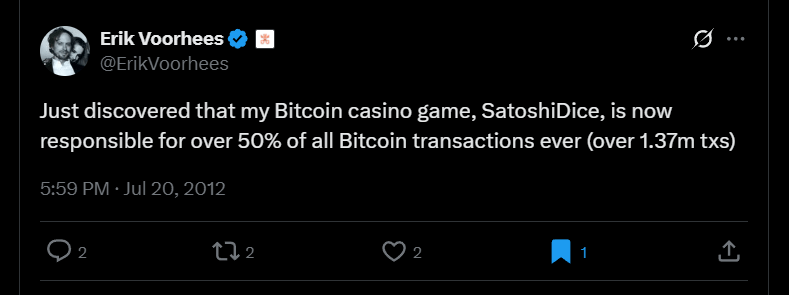
Then came Satoshi Dice in 2012, a bitcoin gambling site once operated by Erik Voorhees, who recently co-founded the privacy-focused AI startup Venice. Players would send bitcoin (BTC) to a Satoshi Dice address. The game would then run the player’s transaction hash through a lottery function. Winners would receive a payout in bitcoin. The game became so popular that at one time, it was responsible for more than half of all bitcoin transactions.
“Bitcoin intended to counter such spam by requiring minimal transaction fees for spammy-looking transactions,” Bitcoin Core contributor Luke Dashjr wrote at the time. “Satoshi Dice, however, uses novel social engineering to exploit gamblers and force them to cover the cost of bypassing Bitcoin’s anti-spam rules.”
Bitmex listed sixteen additional examples of so-called “spam systems” with the intention of proving that spam has always been a challenge for Bitcoin, and that the recent wave of spam ushered in by the Ordinals protocol in 2023 is nothing special.
But Dashjr disagrees, “From 2010 until 2022, Bitcoin used spam filters to keep garbage out of the chain,” he wrote. “In 2022, the ‘Inscription’ exploit was discovered, and we now have 2 full years of its damage to observe.”
After the long-anticipated upgrade to version 30 of Bitcoin Core two weeks ago, the field for storing arbitrary data went from 83 bytes to 100,000 bytes. This means it is now easier to include non-fungible tokens (NFTs) such as Ordinals inscriptions and other non-financial data, commonly considered spam, in Bitcoin blocks. Many are now carefully monitoring the situation to see if this is just another bump along the way as Bitmex characterizes it, or if Bitcoin will be overwhelmed by spam as Dashjr predicts.
“If Bitcoin loses its fundamental properties, it isn’t Bitcoin anymore,” Dashjr said.
FAQ ⚡
- What did Bitmex reveal about Bitcoin spam?
Bitmex traced Bitcoin’s spam problem back to 2011, noting that junk transactions have appeared throughout its history. - Why is spam suddenly a hot topic again?
A recent Bitcoin Core upgrade expanded the data field from 83 bytes to 100,000 bytes, allowing more non-financial data like NFTs. - Who’s leading the current debate?
Bitcoin Core developer Luke Dashjr warns the change could “break Bitcoin,” while Bitmex calls it just another historical spam cycle. - What’s at stake for the network?
If spam overwhelms blocks, it could trigger higher fees, or even a contentious chain split within the Bitcoin community.