On Tuesday, bitcoin traded at $109,936 on Aug. 26, 2025, with a 24-hour price range between $109,214 and $112,815. The digital asset posted a market capitalization of $2.18 trillion, while 24-hour trading volume reached $51.18 billion, pointing to significant market participation amid technical uncertainty.
Bitcoin Price Watch: Moving Averages Align for Further Decline

This article was published more than a month ago. Some information may no longer be current.
WRITTEN BY

SHARE

Bitcoin
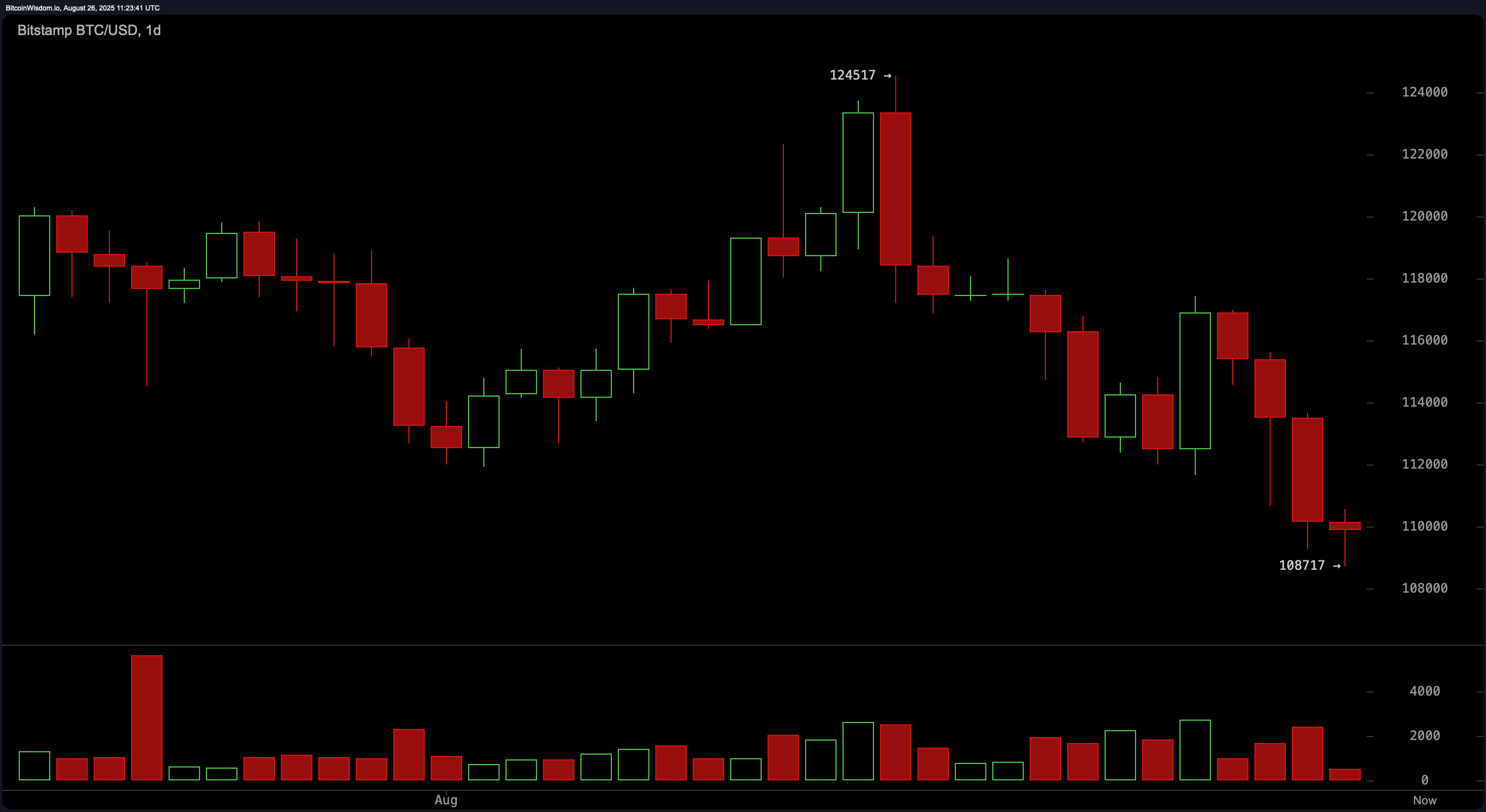
On the daily timeframe, bitcoin remains locked in a defined downtrend, with lower highs and lower lows shaping the price action. A sharp rejection from the recent local top of $124,517 has pulled the price downward by more than 12%, with the latest daily candle closing near $108,717. This pattern is reinforced by bearish engulfing candles and elevated red volume bars, signaling sustained seller dominance. Despite the downward pressure, the emergence of tight-bodied candles may suggest a pause or potential exhaustion phase, though no bullish reversal has been confirmed.
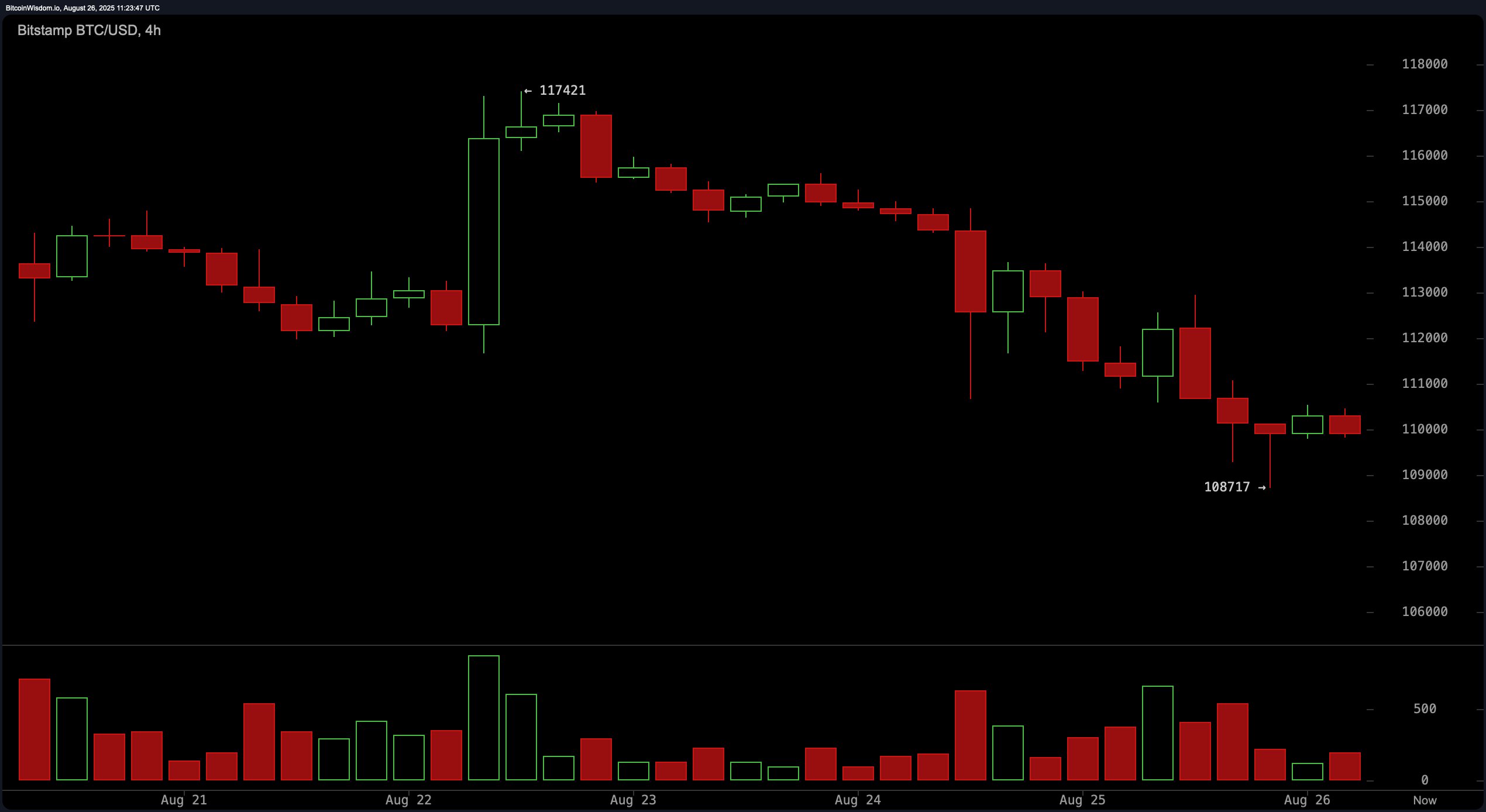
The 4-hour bitcoin chart aligns with this bearish outlook, showing an accelerated decline from $117,421 to $108,717. Attempts to rally have been consistently capped, with each bounce forming lower highs and encountering resistance near $112,000 to $113,000. Bearish volume spikes further corroborate the weakness of bullish momentum. A tentative double-bottom structure near $108,700 appears to be forming, but without confirmation, traders are advised to remain cautious. Short entries on intraday bounces remain favorable as long as the resistance ceiling holds.
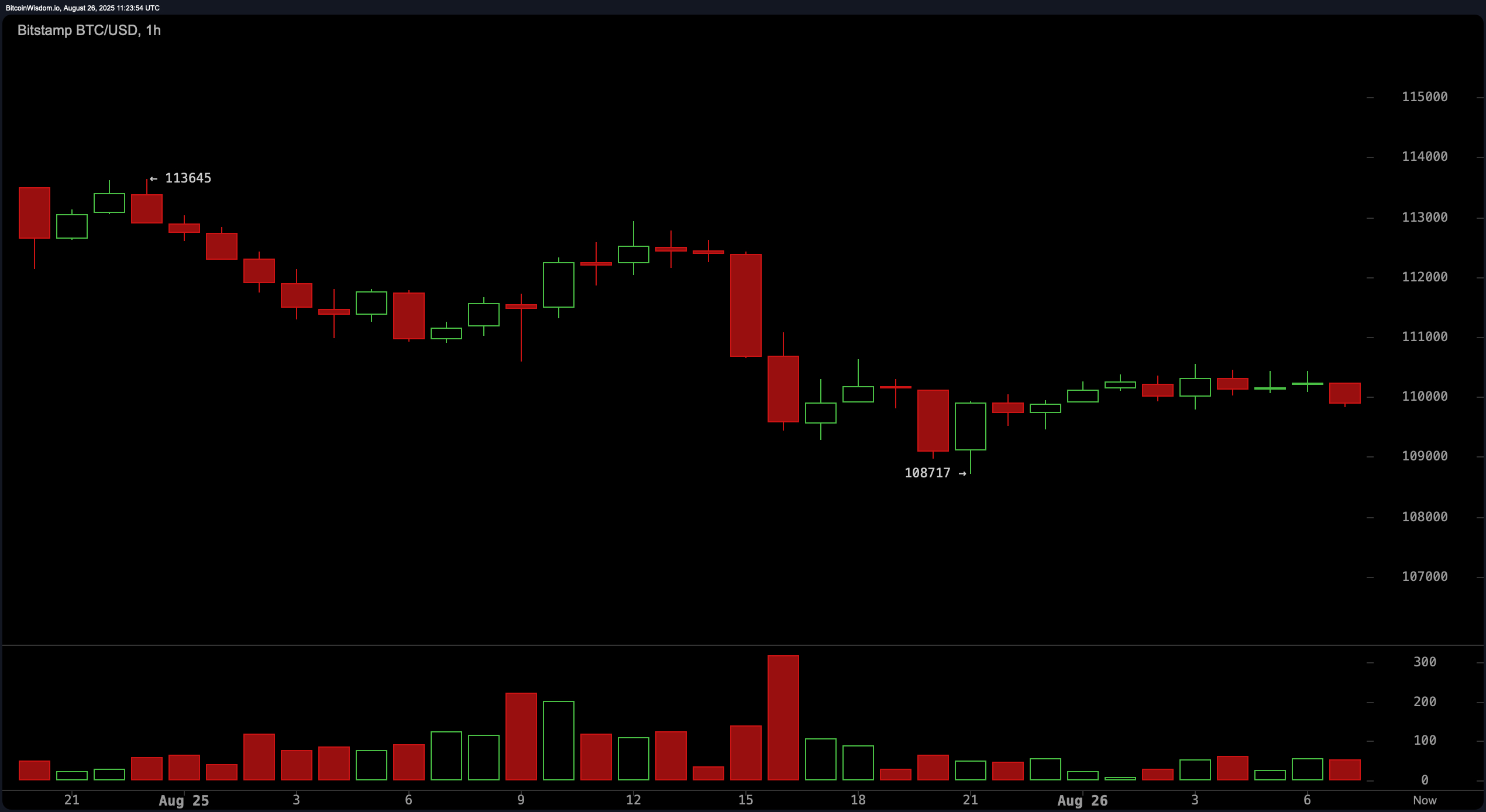
On the 1-hour bitcoin timeframe, the trend transitions from outright bearishness to short-term consolidation. Following the recent decline, bitcoin has stabilized in a narrow range between $109,000 and $110,500. Diminishing candle size and decreasing volume indicate a contraction in volatility. Although buyers have defended the $108,700 support level for now, upward moves have lacked follow-through, suggesting weak conviction. Scalp trades may be considered on well-defined setups, but traders should maintain tight risk controls due to prevailing choppiness.
Oscillator readings provide a mixed but largely neutral picture. The relative strength index ( RSI) is positioned at 38, while the stochastic oscillator is at 11, and the commodity channel index (CCI) is deeply negative at −180 — all signaling indecision. The average directional index (ADX) sits at 17, highlighting the absence of a strong directional trend in the short term. Momentum, however, shows a sell signal at −7,562, while the moving average convergence divergence ( MACD) level is also bearish at −1,184, reinforcing short-term downside risk.
Moving average (MA) data confirms prevailing bearish sentiment, particularly in the short to medium term. The exponential moving averages (EMAs) and simple moving averages (SMAs) across 10-, 20-, 30-, and 50-period intervals all signal a bearish trend, with prices below each respective benchmark. Notably, the 100-period EMAs and SMAs also remain bearish. Only the 200-period exponential moving average and simple moving average reflect buy signals, suggesting that long-term trend support remains intact — though this support is distant from current price levels, limiting its immediate relevance.
Bull Verdict:
While bitcoin’s price remains pressured by near-term bearish momentum, the successful defense of the $108,700 support zone may offer a foundation for reversal. A sustained move above $113,000, coupled with improving volume and oscillator confirmation, would be required to shift the structure toward a bullish recovery.
Bear Verdict:
Technical indicators across multiple timeframes continue to favor the downside, with persistent rejection at key resistance levels and weak momentum confirming bearish control. Unless bitcoin decisively reclaims the $113,000 threshold, sellers are likely to remain in command, with further declines toward $106,000 a plausible next leg.