Two pieces of hardware have emerged in the Bitcoin ecosystem, drawing significant attention. You can’t browse a cryptocurrency forum or news feed without encountering numerous discussions about 21INC’s Bitcoin computer. Additionally, KeepKey recently launched a variant of the “Trezor-style” hardware wallet for $240. The key question is: Are these devices suitable for the evolving Bitcoin landscape, and at what cost?
Bitcoin: Hardware or Software? That Is The Question

This article was published more than a year ago. Some information may no longer be current.
WRITTEN BY

SHARE
The KeyMasters
The debate often centers on a timeless question: Hardware or software? Hardware is tangible; you can touch it, plug it in, and without it, certain software functionalities wouldn’t be possible. Software, on the other hand, isn’t something you can physically grasp, but it’s vital. Without software, optimizing the phones, tablets, and computers we rely on daily would be impossible.
When it comes to KeepKey and hardware wallets, many lean toward hardware. And why not? KeepKey stores private keys in a device designed for cold storage. Just as there are paper wallets for bitcoins, a hardware wallet seems like a logical step.
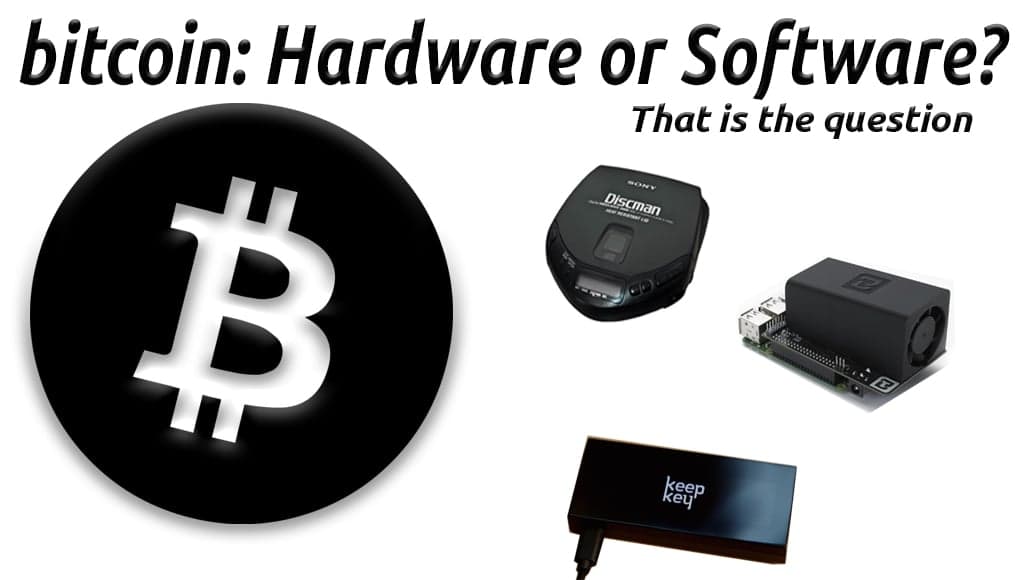
KeepKey’s cold storage hardware wallet is pricier than its competitors, Trezor and Ledger. Yet, the model appears sleek and features an OLED display with active confirmation buttons. The wallet, which connects through a USB cable, is compatible with Google Chrome extensions and is touted as being fully malware and virus-resistant. Founder Darin Stanchfield believes their product is user-friendly, noting:
Our security model was designed to ensure that the user always has complete control over their private keys, — We feel that relying on trusted third parties degrades the security and privacy that the bitcoin ecosystem offers.
The allure of hardware wallets has surged since historical breaches and financial collapses, including the notorious Mt Gox debacle. These devices offer a fortified sanctuary for your bitcoins, with many enjoying support from reputable wallet platforms like Mycelium and Electrum. In terms of security, it’s a clear win. The design is chic, but the $239 price point might raise eyebrows when stacked against rival models.
21 Questions for the ‘21 Computer’
The age-old debate of Hardware vs. Software gets a fresh twist with 21INC’s introduction of the “first Bitcoin computer.” Is shelling out $400 on Amazon for a dedicated device justified, or could its capabilities be integrated into gadgets we already possess? The intrigue peaked in March 2015 when 21INC, co-founded by luminaries like Andreessen Horowitz and Balaji Srinivasan, announced a staggering $116 million in venture capital funding, leaving many speculating about the firm’s core mission. Early hints dropped with images of toasters. As the curtain lifted, the company unveiled ambitions to embed ASIC technology into everyday items – from routers and toasters to set-top boxes and chipsets. Collaborating with tech giants Qualcomm and Intel, 21INC pioneered the innovative “split chip” design. Their enthusiasm was palpable; the startup envisioned democratizing access to the Bitcoin network, extending it beyond the confines of Silicon Valley.
Co-founder Matthew Pauker told the Wall Street Journal:
Bitcoin is going to change the way that people and businesses and even machines interact with each other,” he says. “But for Bitcoin to realize that vision we need mass adoption. It can’t just be for Silicon Valley.
The much-anticipated “toaster,” also dubbed the “21 Bitcoin Computer,” has hit the market, with shipments set to roll out from the firm’s base come November. This compact gadget, a Raspberry Pi minicomputer at its core, boasts a bespoke 21INC mining chip, enabling modest mining endeavors right from your cozy nook. While it’s a favorite among coding maestros and budding developers, this nifty device welcomes anyone keen on crafting innovative features. Primarily pitched for the developmental sphere, it’s envisioned as a toolkit for the Internet of Things. 21INC’s grand vision? A dazzling spread where chipset technology is not just a fad but a ubiquitous marvel, gracing everything from toasters and USB chargers to smartphones.
Ben Horowitz, co-founder of Andreessen Horowitz told the WSJ:
“I’m very excited about it. The thing that’s completely missing that I think would make the Internet better would be machine-to-machine payments. It’s just amazingly hard to do right now.”
Conversely, the discourse on software emerges, highlighting that identical hardware, sans the “chip work,” could be crafted for a fraction—just a third—of the cost. Many argue that the Bitcoin protocol doesn’t necessitate any “unique” hardware, finding its home more seamlessly in the software domain. As the digital age progresses, the reliance on hardware wanes, with cloud computing and software taking the reins. Currently, these cloud and software services are the tech world’s hottest commodities, and their ascendancy is nothing short of meteoric. Even Horowitz’s website states: “Software Is Eating the World.”
As technologies accelerate, it is said by some innovators that it’s the software that pushes the envelope. Advocates of the software-first approach say that “software is eating hardware,” and products are only as good as the experience that gives them life. Adam Macbeth, who helped develop innovative concepts such as the iPod and FiftyThree’s Pencil, holds this belief. Macbeth described to firstround.com that software is everything, stating:
“People think that they can build a game-changer with some really great industrial design and packaging, but that’s not the case anymore, Incredible industrial design is increasingly non-optional, what really matters is an equally beautiful software system that spans mobile, desktop, and more. It’s something that takes a lot of thought to get right.”
In the realm of bitcoin, software and devices are primarily tasked with algorithmic calculations. Given the pivotal role mobile phones play in propelling Bitcoin, they seem ideally positioned for a vast network where software steers our mobile connectivity. Moreover, most gadgets, aside from sizable phones and tablets, are undergoing a miniaturization trend, evolving to the point where everything is essentially a “chip.”
So where does this leave companies aiming to settle the enduring hardware vs. software debate that ignited in the early eighties? Devices like Ledger, Trezor, and the recent KeepKey have garnered acclaim as the gold standard for fortified security. Yet, can they truly outshine the simplicity of paper? If these enterprises face bankruptcy or shut down their servers, what’s the contingency for transferring millions of keys to a different wallet? Is 21INC’s so-called mini-bitcoin-computer just a dressed-up Raspberry Pi riding a wave of savvy marketing? Imagine being a budding developer, interning at giants like Intel, IBM, or Cisco with a penchant for cryptocurrency—does this gadget resonate? Some argue that novices unfamiliar with command line intricacies might find the device daunting or even unappealing. The aspiration? A straightforward software or cloud interface tailored for the everyday user. Hence, there’s a portion of the audience questioning 21INC’s latest venture and its ability to deliver such seamless spontaneity.
Vitalik Buterin at Ethereum says:
“So you’re paying $399 upfront and getting $0.105 per day or $38.3 per year, and this is before taking into account network difficulty increases, the upcoming block halving (yay, your profit goes down to $0.03 per day!) and, of course, the near-100% likelihood that you won’t be able to keep that device on absolutely all of the time. I seriously hope they have multiple mining chips inside of their device and forgot to mention it; otherwise you can out compete this offering pretty easily by just pre loading a raspberry pi with $200 of your favorite cryptotokens.”
The naysayers might be off the mark; this could very well follow the trajectory of iconic hardware devices of yesteryears. Remember the evolution from Sony Discman and cumbersome CD collections to sleek MP3 players? Innovations emerged, offering a clutter-free music experience. Hardware isn’t fading away anytime soon. While software is indispensable, it’s intrinsically tied to its hardware counterpart. Yet, there’s a growing sentiment that specialized Bitcoin hardware might not be the best fit for a network that aspires to span every device and platform.
The intriguing twist? These products haven’t even hit the market yet. Casting judgments on tangible products or software pre-launch might be premature. While there’s no denying the urgency for Bitcoin security, and hardware wallets bring commendable solutions to safeguard user keys, their indispensability remains debatable. It’s worth noting that 21INC’s venture might just ignite widespread interest. It’s not merely about the petite mining chip ensuring a return on investment. The device holds the potential to revolutionize internet advertising by integrating micropayments, and possibly phasing out the age-old hassle of passwords and logins. But, of course, this hinges on the big “if” – the widespread adoption of something as avant-garde as 21INC’s computer.
What do you think of this hardware and software debate? Let us know in the comments below.