Following the prior difficulty recalibration that occurred 2,016 blocks ago—roughly two weeks back on Feb. 7—the Bitcoin protocol has now delivered a sharp counterpunch. On Thursday, at block height 937440, mining difficulty climbed 14.73%, effectively wiping out the earlier steep reduction and reminding participants that in this arena, gravity is optional and reversals are swift.
Bitcoin Difficulty Whipsaws From 11% Slide to 14.73% Climb in 2 Weeks
WRITTEN BY

SHARE

Revenue Near Multi-Year Lows as Bitcoin Difficulty Climbs 14.73%
Bitcoin’s difficulty registered a steep decline on Feb. 7, marking the most pronounced downward adjustment since 2021, when China prohibited bitcoin mining within its borders. At block 935424, the metric fell 11.16%, a notable retreat by any measure.
The pullback was driven in part by an Arctic storm that battered the United States, prompting U.S.-based miners to scale back operations to ease pressure on the power grid. But when operators flipped the switches back on, they returned with intensity, even as revenue lingers at multi-year lows.
Hashrate vaulted beyond the 1 zettahash per second (ZH/s) threshold, compressing block intervals well below the 10-minute norm and setting the stage for Thursday’s adjustment. As Bitcoin.com News previously reported, the latest epoch not only reversed the 11.16% drop but exceeded it, climbing 14.73% and effectively canceling out the earlier retreat.
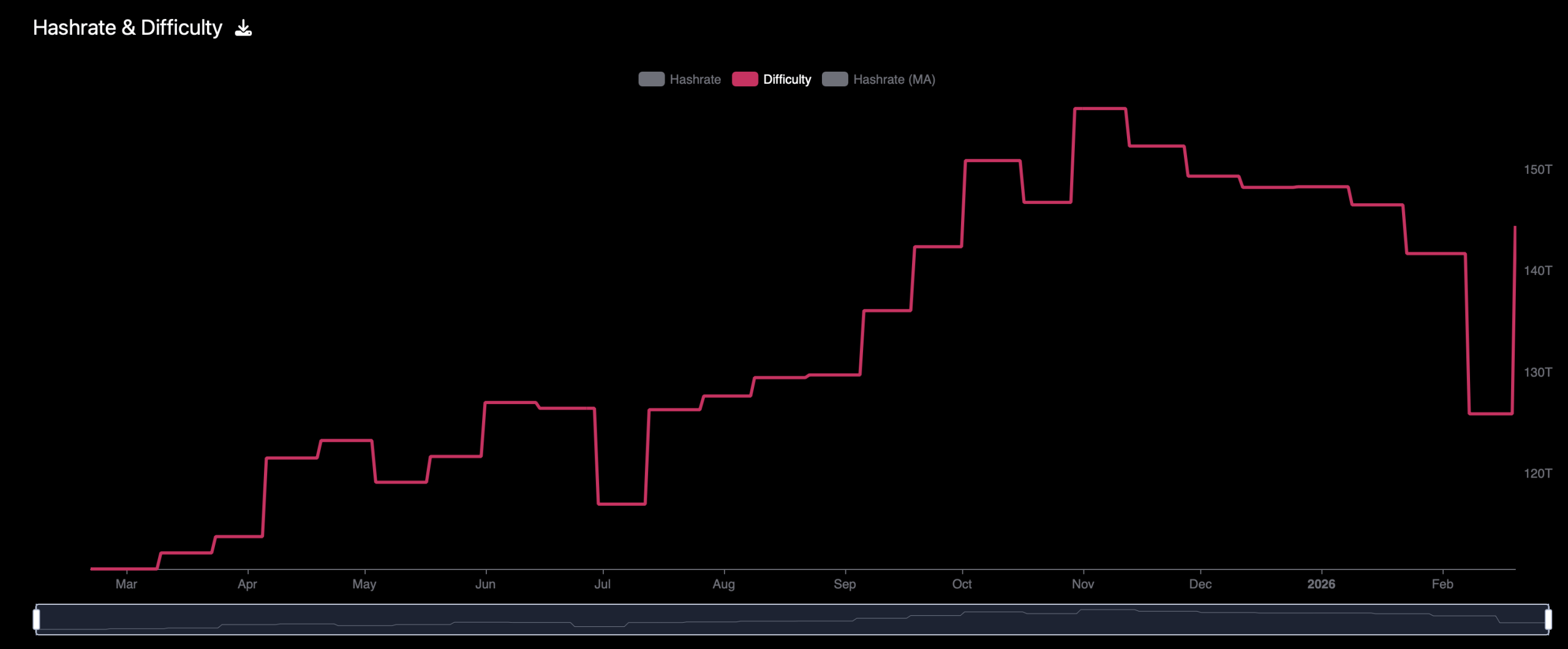
Once again, the network delivered a jolt not seen since 2021—specifically at block 683,424 on May 13, 2021—when difficulty advanced 21.53%. Since then, there have been meaningful gains above 13%, including block 758,016 on Oct. 10, 2022.
Thursday’s recalibration stands out, and while hashrate has climbed and block production has accelerated, miner revenue has fallen even further than during the Arctic storm curtailments. Miners are currently earning $29.30 per petahash per second (PH/s), according to hashprice data tracked by hashrateindex.com.
Bitcoin Miner Soluna Expands Behind-the-Meter Capacity in Texas via Blockware Pact
Soluna Holdings is deepening its ties with Blockware, adding 6 megawatts (MW) of capacity at Project Dorothy 1 in West…
Read Now

Bitcoin Miner Soluna Expands Behind-the-Meter Capacity in Texas via Blockware Pact
Soluna Holdings is deepening its ties with Blockware, adding 6 megawatts (MW) of capacity at Project Dorothy 1 in West…
Read NowBitcoin Miner Soluna Expands Behind-the-Meter Capacity in Texas via Blockware Pact
Read NowSoluna Holdings is deepening its ties with Blockware, adding 6 megawatts (MW) of capacity at Project Dorothy 1 in West…
Hashprice has not hovered at these levels since bitcoin traded below two digits in its infancy. A 14.73% increase in difficulty, under such lean conditions, tightens margins further and makes the daily grind of mining an even more exacting enterprise.
Bitcoin’s latest adjustment illustrates a network that recalibrates with mechanical precision, indifferent to miner margins or meteorological drama. Whether operators can sustain this pace with hashprice scraping historic lows will determine how long this high-difficulty chapter endures.
FAQ ❓
- What happened to Bitcoin mining difficulty on Thursday? Bitcoin’s mining difficulty increased 14.73%, fully reversing the 11.16% decrease recorded on Feb. 7.
- Why did Bitcoin difficulty drop on Feb. 7? The 11.16% decline at block 935424 followed an Arctic storm in the United States that led miners to temporarily scale back operations.
- How high did Bitcoin’s hashrate climb after miners returned? The network’s hashrate pushed above 1 zettahash per second (ZH/s), accelerating block times and triggering the latest adjustment.
- What does a 14.73% difficulty increase mean for miners? A higher difficulty raises competition and compresses margins, especially with hashprice hovering near multi-year lows.