


A Bitcoin Improvement Proposal (BIP-110) pushing to ban Ordinals-style data inscriptions at the consensus level is barreling toward an activation window in early August, with less than 1% of mining hashrate behind it, raising legitimate concerns about a persistent chain split.
BIP-110 Pushes Bitcoin Toward August Fork Deadline With Only 5 EH/s Signaling
WRITTEN BY

SHARE

Key Takeaways
- BIP-110 targets Ordinals and inscription data with a 1-year soft fork, facing 0.31% miner signaling as of June 2026.
- Adam Back and Jameson Lopp warn that the proposal risks a Bitcoin chain split, calling activation parameters reckless and technically flawed.
- A mandatory signaling window at block 961632 (est. Aug. 7, 2026) will test whether Ocean pool and node runners can force compliance without miner majority support.
What BIP-110 Actually Does
BIP-110, authored by Dathon Ohm and formally titled the Reduced Data Temporary Soft fork, proposes a one-year consensus-level restriction on arbitrary data embedding in bitcoin transactions. The rules would target the most common methods used for Ordinals inscriptions, large OP_RETURN payloads, BRC-20 tokens, and certain Taproot constructions repurposed for data storage.
The proposal is written as a fork, albeit a soft fork, meaning its new rules are stricter than existing ones, but backward compatible. Standard monetary transactions using P2PKH, P2WPKH, or Taproot key-path spends would remain fully valid. After 52,416 blocks (roughly one year), the rules expire automatically with no lingering enforcement.
Supporters say it addresses a real problem: data storage competing with payments raises fees, increases node operating costs, and bends Bitcoin’s incentive structure away from its monetary purpose.
The Numbers That Define the Risk
The activation parameters are aggressive. BIP-110 uses a modified BIP9 deployment requiring only 55% miner signaling (1,109 of 2,016 blocks per retarget period) rather than the traditional 95% threshold. If that threshold is not met naturally, a mandatory signaling window beginning around block 961632 (projected Aug. 7, 2026) will reject any block that fails to signal bit 4.
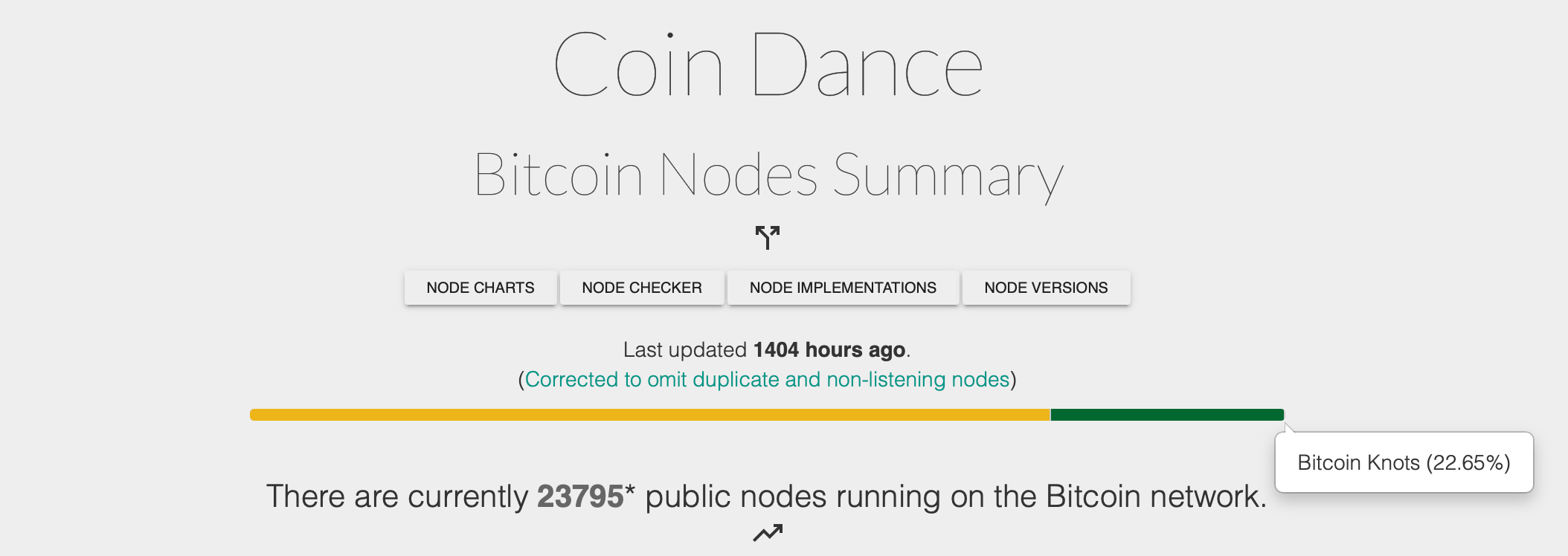
As of late June 2026, miner signaling sits at 0.31% of total hashrate, around 5 EH/s out of a network total near 940 EH/s. More recently, over the last day, the website bip110.org/monitor shows signaling at 0.00%. Ocean pool has produced the majority of signaling blocks since the first appeared in March 2026. Node adoption for BIP-110-capable software (primarily Bitcoin Knots variants) ranges from an estimated 2% to 8% of listening nodes, though some figures are disputed.
How a Split Happens
Bitcoin’s heaviest-chain rule is what makes this dangerous. If enforcing nodes and sympathetic miners begin rejecting blocks that contain non-compliant transactions, and those blocks carry valid proof-of-work under legacy rules, two competing chains emerge. Enforcing nodes build one chain. Legacy nodes follow another.
A minority-enforcement scenario would likely produce a slower, lower-hashrate BIP-110 chain as difficulty adjusts downward. That chain could survive or wither depending on whether exchanges, wallets, and users assign it economic value. The disruption itself, including halted exchange deposits, replay risk, and infrastructure confusion, would occur regardless of which chain ultimately prevails.
Critics: ‘This Is Not the Way’
Adam Back, the cypherpunk and Blockstream co-founder, has been direct on X, stating: “It really doesn’t work, breaks multiple things, doesn’t have tech nor ecosystem consensus. Each is fatal. It has all four. We all hate spam. But this is not the way. You’re gonna hurt yourselves.”
Jameson Lopp published a detailed analysis calling BIP-110 “reckless” and “doomed to fail.” His critique covers split risk, potential unspendable UTXOs in rare Taproot edge cases, the proposal’s ineffectiveness at actually stopping data storage long-term (embedding can be done in other ways), and the compatibility burden it places on wallets, Miniscript tooling, and pre-signed transactions.
“BIP-110’s activation relies on a low 55% miner signaling threshold for a User-Activated Soft Fork (UASF),” Lopp’s blog post explains. “This greatly increases the chances of a ‘chain split, ‘ in which there are 2 competing chains vying to be ‘the real Bitcoin.’ During a chain split scenario you should expect the entire ecosystem to grind to a halt as a result of uncertainty around which fork will win and resulting double-spend risks.”
Jimmy Song drew heavy criticism on X after declining to take a position, writing that he lacked sufficient knowledge of the consequences. “I am not ‘for’ or ‘against’ BIP110. The reason being that I don’t know enough about the system to know the consequences of either path. We’ll know a little more when the soft fork resolves one way or the other, but currently, I have little idea of how anything plays out,” Song explained.
Pro-BIP-110 accounts interpreted his neutrality as audience capture and doing nothing. While caution is commendable, taking it to this extreme leads to total inaction, BIP-110 proponent dubbed the Softfork Mechanic explained. “I respect the humility of course, but this exceeds that and becomes paralysis. Bitcoin is not entirely static,” the Softfork Mechanic wrote to Song.
The X account added:
“Segwit and Taproot were enormous changes with some horrible consequences. BIP110 is an extremely minor guardrail placed on the latter and it is easy to conclude both that it is necessary given the damage taproot did in practice whilst vanishingly unlikely to have further unforseen consequences itself.”
Blockstream’s Back also responded to Song’s post as well. “There’s no technical consensus,” Back insisted.
Supporters Push Back
Supporters also argue miners will not sacrifice block rewards over spam fees once the choice becomes real, limiting sustained split risk. Others invoke BIP148, the 2017 UASF that helped force Segwit activation, as precedent for user-activated pressure working despite miner resistance.
Matteo Pellegrini recently reached out to a large audience on Club Orange, a bitcoin-only social network, sending messages to roughly 17,000 people and asking them to “zap me back if they support BIP110.” With a daily active user base of about 500, Pellegrini said he had already received over 100 positive responses. Pellegrini concludes that if this level of engagement mirrors the broader network of “node runners,” we should “expect 20-25% of nodes supporting BIP110.”
What Comes Next
BIP-110 expires automatically if it activates and no follow-on proposal extends it. Whether it passes or fails, the proposal has already forced Bitcoin’s governance tension into the open: node runners versus miners, spam protection versus data freedom, UASF urgency versus broad consensus requirements.
The mandatory block window arrives in approximately six weeks. That is enough time for signaling to shift dramatically or for the ecosystem to move firmly in the other direction.

Bitcoin is approaching a compressed August 2026 window in which BIP-110’s mandatory signaling mechanics are scheduled to arrive shortly before…
Read Now: August Timeline Puts Bitcoin BIP-110 Signaling and Paul Sztorc’s Hard Fork in Focus