A social media post by an X account named “Wicked” presents claims that Satoshi Nakamoto may have conducted 51% attacks on the Bitcoin blockchain in May 2009. Wicked speculated that Satoshi likely tested these attacks early on to understand their potential impact on the network.
Analysis Reveals Possible 51% Attacks by Satoshi on Bitcoin in Early 2009

This article was published more than a year ago. Some information may no longer be current.
WRITTEN BY

SHARE

Claims Surface Suggesting Satoshi Nakamoto Tested 51% Attacks on Bitcoin in 2009
This week, discussions within the crypto community have centered around a post by Wicked, shared on Sept. 29, following the transfer of several 2009 BTC blocks last month. “More odd behavior seen on Bitcoin from Satoshi in May 2009. With over 75% of the hashrate at the time, my best guess is that he was testing out how 51% attacks would actually work,” Wicked said. He continued, “By 51% attacking the network a few times throughout this week from the 19th to the 25th.”
Wicked also provided a chart, explaining that it illustrated the ExtraNonce data in the coinbase transaction of each block. He pointed out that back then, most participants were iterating the ExtraNonce one way, while Satoshi used a different method. As a result, the blocks Satoshi mined, highlighted in orange, stand out distinctly.
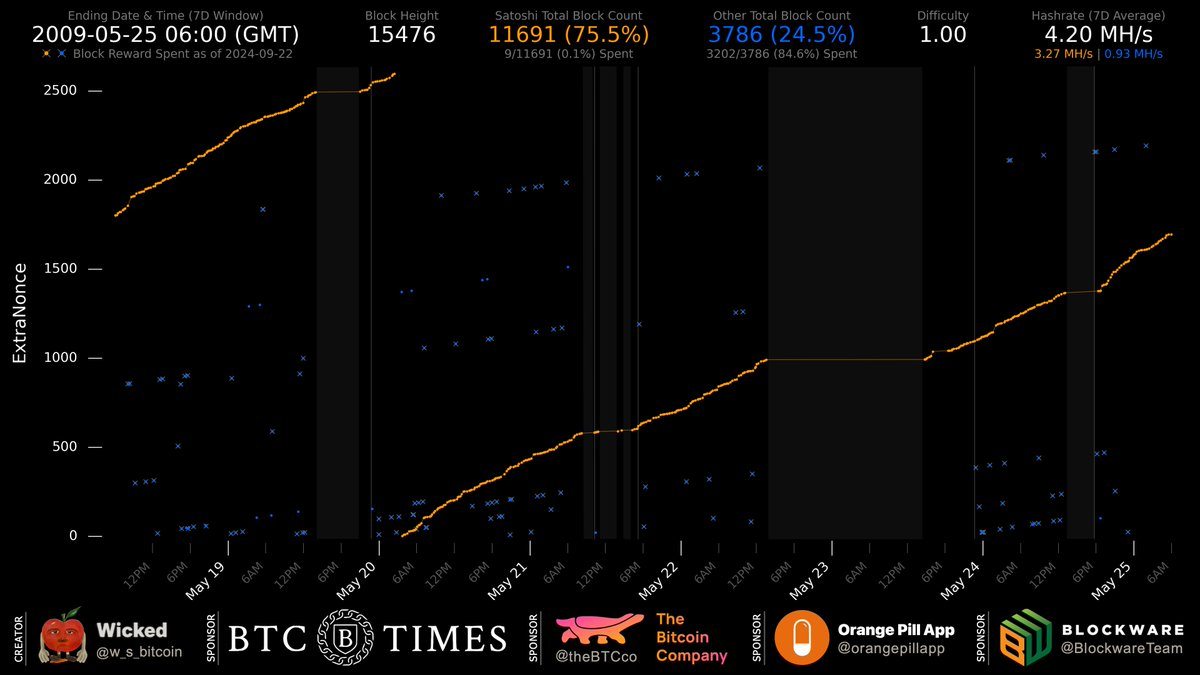
Wicked suggested it was either intentional or possibly accidental, with Satoshi perhaps unaware of it. The X account also noted the curious absence of any known emails from Satoshi or other early adopters discussing any reorgs during that week. Still, Wicked expressed confidence, stating, “I’m pretty confident that that’s what we’re seeing here.”
Jameson Lopp described it as unusual that the extraNonce remained static during those gaps, indicating the mining software continued to operate without crashing or restarting. However, he also said it also implies that no additional blocks were being mined during that time. Lopp proposed that one possible reason could be that Satoshi manually adjusted the clock on their machine.
Lopp also speculated that a lost internet connection might have caused the software to freeze, as it would pause if no peers were available. “I’m following the accidental re-org theory but am puzzled by the amount of occurrences. Not surprised that no one noticed,” another X account posted in Wicked’s thread. The limited data available and the uncertainties surrounding the development period from 2009 to 2010 offer few clues as to the true significance of Wicked’s findings.
The recent discussions surrounding Satoshi Nakamoto’s potential involvement in 51% attacks underscore the ongoing fascination with Bitcoin’s early development and the unknowns that persist. While theories abound, these speculations highlight the complexity of blockchain technology, and how even today, the actions of Bitcoin’s creator continue to spark debates within the crypto community, with more questions than concrete answers.
What do you think about the theories that Satoshi may have been testing the Bitcoin network at that time? Do you think Lopp’s theories sound plausible? Share your thoughts and opinions about this subject in the comments section below.