Thomas Joseph Webster, Professor Emeritus of Economics at Pace University, challenges the long-held belief in the Federal Reserve’s political independence in his comprehensive report, “The Myth of Fed Political Independence.” Webster’s research scrutinizes the relationship between fiscal and monetary policies, arguing that the Federal Reserve operates more as a political tool than an independent entity.
Academic Paper Questions Federal Reserve Independence and Exposes Political Ties

This article was published more than a year ago. Some information may no longer be current.
WRITTEN BY

SHARE
Comprehensive Study Takes a Closer Look at Political Influence Over the U.S. Federal Reserve
Webster’s paper argues that the Federal Reserve is deeply intertwined with the political machinery of the United States government, serving as a financier for Congress rather than an independent body focused solely on economic stability. According to Webster, the Fed’s involvement in purchasing U.S. Treasury securities—especially during periods of significant fiscal deficits—reveals its role in accommodating congressional spending. This relationship, he suggests, undermines the central bank’s mandate to maintain price stability and protect the economy from inflation.
In the study, Webster speaks about the global financial crisis (GFC) from 2010 until the closing weeks of 2021. “During this period, the Fed was less concerned with the effect that expanding budget deficits were having on the general price level and more concerned with abetting the budget agenda of the White House and Congress,” the report explains.
Webster adds:
According to a Federal Open Market Committee (FOMC) insider, it was politically difficult for the Fed to end quantitative easing because Congress and private-sector business interests had become addicted to cheap money.
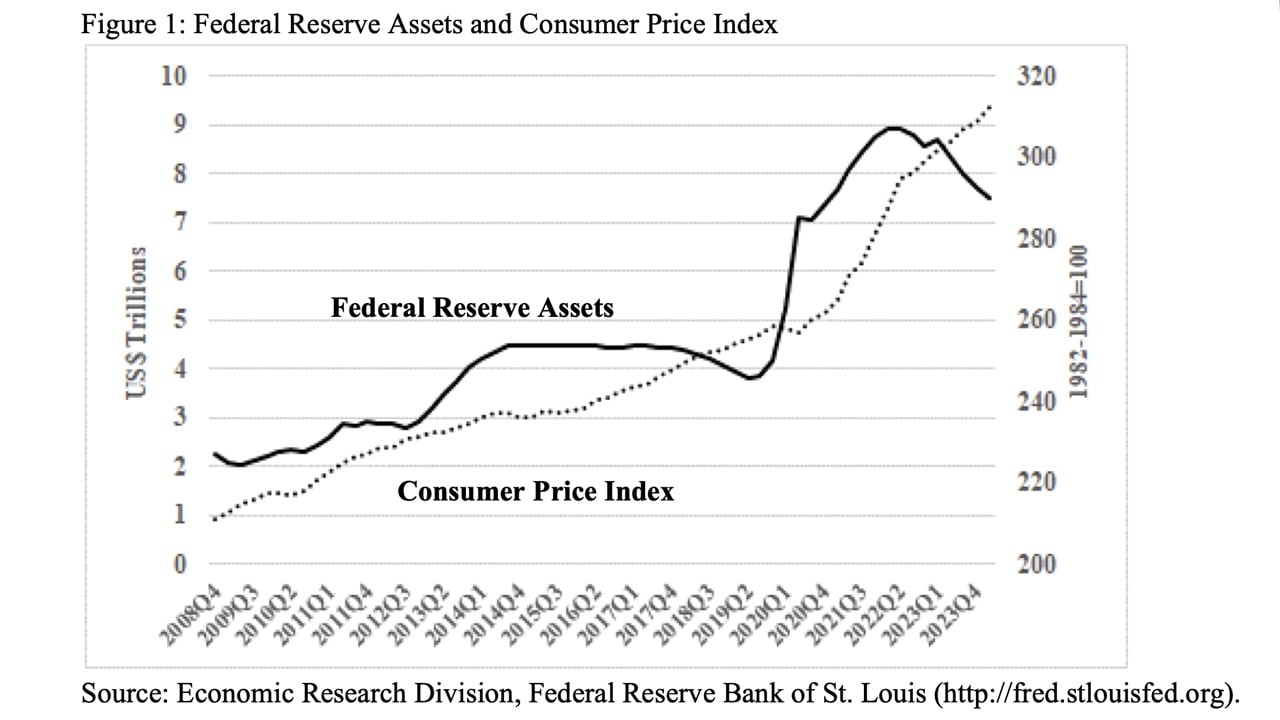
The paper provides empirical evidence to support the claim that the U.S. central bank’s monetary policies are heavily influenced by political agendas. Webster highlights the Fed’s quantitative easing (QE) program, initiated during the global financial crisis of 2008 and continued through subsequent years, as a prime example of the institution’s complicity in enabling government spending. The rapid expansion of the Fed’s balance sheet, coupled with rising consumer prices, is presented as evidence of the central bank’s departure from its primary objectives in favor of political expediency.
Webster notes:
Between 2008 Q4 and 2021 Q1 the Fed’s balance sheet increased from $2.4 trillion to $8.8 trillion. During that same period, the CPI increased 32 percent from about 211 to 280.
Webster concludes that the perceived independence of the Federal Reserve is largely a myth, arguing that the institution has become a politically co-opted agency. His analysis suggests that the Fed’s actions, particularly in the aftermath of the financial crisis, were more about supporting the government’s fiscal policies than ensuring economic stability. As a result, Webster contends that the Fed’s policies have disproportionately impacted low- and middle-income households, further calling into question the central bank’s role in safeguarding the broader economy.
What do you think about the research paper that questions the Fed’s independence? Share your thoughts and opinions about this subject in the comments section below.
Bitcoin.com News is seeking a News Writer to produce daily content on cryptocurrency, blockchain, and the digital currency ecosystem. If you are interested in becoming a key member of our innovative global team, apply here.