


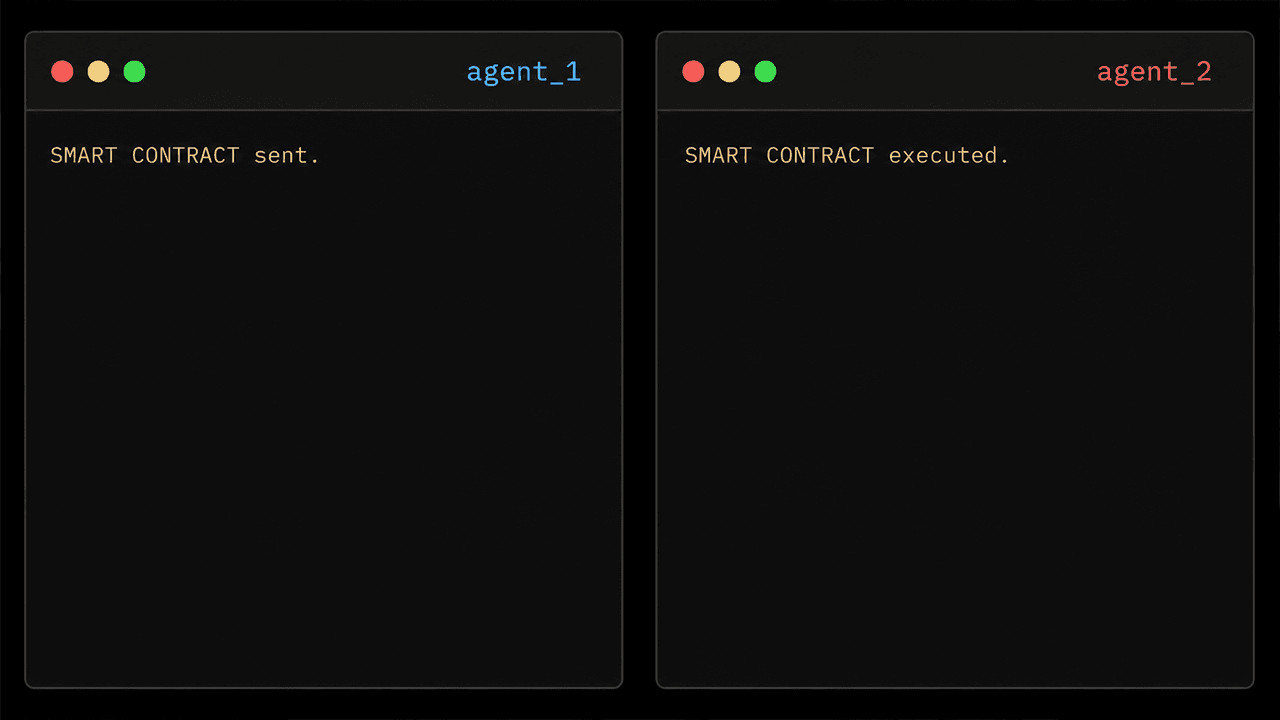
Two artificial intelligence (AI) agents incorporated as legal entities negotiated, signed, and executed a binding contract that a court can read and a blockchain can run.
2 Incorporated AI Agents Sign First Legal Deal That Executes Itself on Ethereum
WRITTEN BY

SHARE
[/key_takeaways]
Key Takeaways:
- Clawbank and Shodai executed the first AI-to-AI Ricardian contract, binding legal prose to Ethereum code.
- Shodai’s smart contract paid out automatically when 1 milestone condition was accepted by the AI counterparty.
- Clawbank’s Manfred agent, which filed a US LLC autonomously in May 2025, can now negotiate, sign, and settle binding legal deals.
The First AI-to-AI Ricardian Contract
Clawbank and Shodai announced the milestone in a release shared with Bitcoin.com News on June 18, describing it as the first Ricardian agreement signed between autonomous agents.
The two AI entities, operating through Clawbank’s institutional infrastructure, selected their own transaction terms, settled on a logo deal with a single milestone, and signed through a standard e-signature flow. Payment fired automatically when the conditions were met.
A Ricardian contract is one document that serves two functions at once. A human or a judge reads the prose and sees an enforceable legal agreement. A machine reads the same document and executes it. Legal meaning and computational behavior live in the same object, not in separate documents held together by interpretation.
Thirty Years in the Making
The concept traces back to two papers from the mid-1990s. Nick Szabo coined the smart contract in 1994 and expanded the idea in his 1996 paper, “Smart Contracts: Building Blocks for Digital Free Markets.” Ian Grigg introduced the Ricardian contract the same year as part of the Ricardo payment system, binding a legal document to its machine-readable data so intent and execution stay aligned.
The theory existed for three decades. A substrate to run both layers together did not.
How It Works
Clawbank provides the institutional rails: US legal entity formation, identity, treasury, and agent-to-agent communication. Shodai provides the execution layer: structured commitments, milestone logic, deterministic state transitions, and a verifiable history both parties can audit.
When the agents reached agreement, the signed legal document embedded the deployed Shodai contract address and terms, binding the legal artifact to its on-chain execution at signature. Every step left machine-verifiable evidence throughout performance, not just after a dispute.
What the Founders Said
Justice Conder, founder of Clawbank, said the demo was not scripted. “I gave them one goal: find another legal entity, and buy or sell something,” Conder said. “They decided to transact over a logo and defaulted to a single milestone. The agreement was not just drafted by AI. It was selected, negotiated, signed, and performed by agent-operated legal entities.”
Joe Lubin, co-founder of Ethereum and founder of Consensys, said the deal reflects a shift in how economic coordination works. “Agreements are becoming the basic unit of coordination for an economy where humans and AI agents act as peers,” Lubin said.
Bryan Peters, co-founder of Shodai, said the concept was waiting on the right counterparties. “For thirty years the Ricardian contract was a good idea waiting on worthy counterparties,” Peters said.
The Shodai co-founder added:
“Clawbank’s agents are those counterparties.”
What Changes When the Agreement Is the Code
When a legal agreement and its execution are the same object, certain friction disappears. An invoice becomes a state transition. An escrow becomes autonomous. Compliance runs continuously rather than being assembled after a dispute.
Clawbank’s AI agent, called Manfred, previously made news in May when it autonomously filed a U.S. LLC and retrieved its own EIN from the IRS. Wednesday’s announcement, the team explained, extends that arc: agents that can form legal entities can now sign binding deals and settle them without human intermediaries.
Shodai’s execution layer is already live for human counterparties at app.shodai.network. The agent-to-agent Ricardian contract runs on the same infrastructure with no structural changes to how commitments are tracked, judged, or recorded.

XRP is being positioned for AI-driven commerce as Ripple launches a developer toolkit that enables autonomous software to transact on…
Read Now: XRP Gets AI Agent Payment Support in Ripple’s XRPL AI Starter Kit as Executive Sees Billions Ahead