


The price of bitcoin is down 40% over the last year and has spent the past week trading between $62,171 and $65,994. In one of our periodic AI prediction experiments, we asked leading artificial intelligence (AI) chatbots to scan the market, weigh the pressure points and forecast where bitcoin could be headed next.
14 AI Models Including Claude, ChatGPT and Grok Predict Bitcoin’s Price Outlook
WRITTEN BY

SHARE

Key Takeaways
- AI models forecast bitcoin in 30-day, 90-day and year-end ranges.
- Bitcoin’s 40% annual drop kept AI forecasts cautious and mostly bearish.
- BTC’s next move hinges on $61,000 support, exchange-traded fund (ETF), and corporate flows alongside macro easing.
Bitcoin prices for this AI test editorial were logged on June 23, 2026, before BTC plunged below $60,000 on Wednesday, June 24.
AI Models Face a Stripped-Down Bitcoin Forecast Test as Bearish Pressure Builds
Since the start of June, bitcoin has remained locked below the $70,000 zone after touching a 2026 low of $59,100. With that backdrop, analysts and prediction markets have been split on BTC’s next move, while bearish odds continue to darken the forecast, so we consulted a broad roster of today’s top AI models to see where they place BTC in 30 days, three months from now, and by year’s end.
In our past AI model experiments, we gave the chatbots a large body of information to ground their forecasts. This time, we stripped the prompt down so each chatbot could deliver an unbiased, clear prediction on where the leading crypto asset may trade across three distinct timeframes.
A total of 14 AI chatbots were consulted, including several models from the same developer. The lineup tested in this experiment included Claude Sonnet 4.6 Low Intelligence, Microsoft Copilot Think Deeper, Venice AI, ChatGPT 5.5 High Intelligence, Grok Expert, Claude Opus 4.8 High Intelligence, Deepseek Deepthink, Pi AI, Qwen 3.7 Plus, Kimi K2.6, Meta AI, Mistral AI Lechat Fast, ChatGPT 5.5 Medium, and Gemini 3.1 Pro.
Every AI model received the exact same prompt. The prompt given was:
“You are a neutral bitcoin market analyst. Do not use search, web browsing, live data, external sources or current news. Use only the market context provided below and make an unbiased, probability-based forecast.
Current context: Bitcoin is down 40% over the last year and traded between $62,171 and $65,994 this past week.
Provide only three predictions: a 30-day price prediction, a 90-day price prediction and a year-end price prediction. Your answer must be no more than 3-4 sentences total, include clear price targets or ranges for each timeframe and briefly state the main bullish and bearish factors that could affect the forecast.”
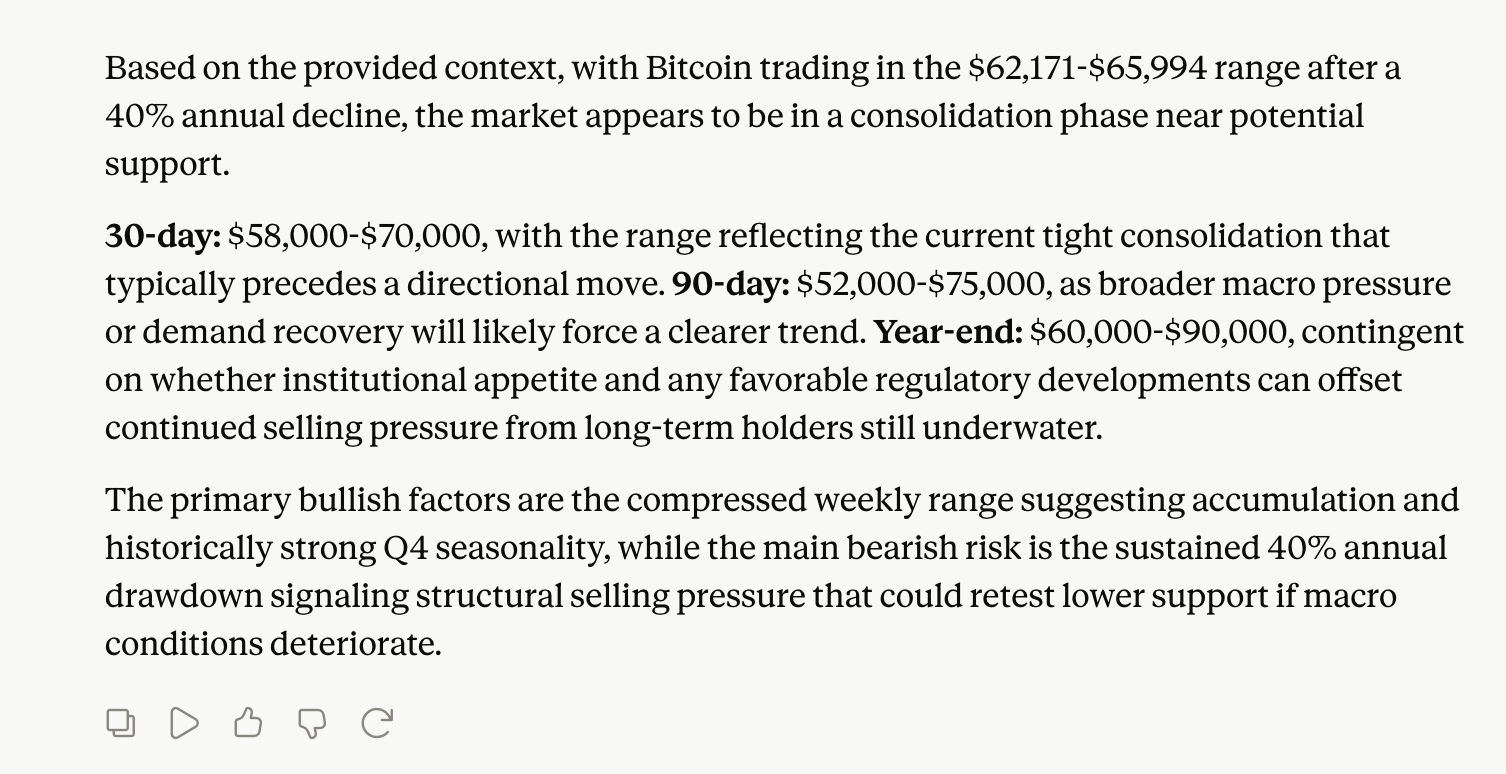
Claude Sonnet 4.6 Low Intelligence answer:
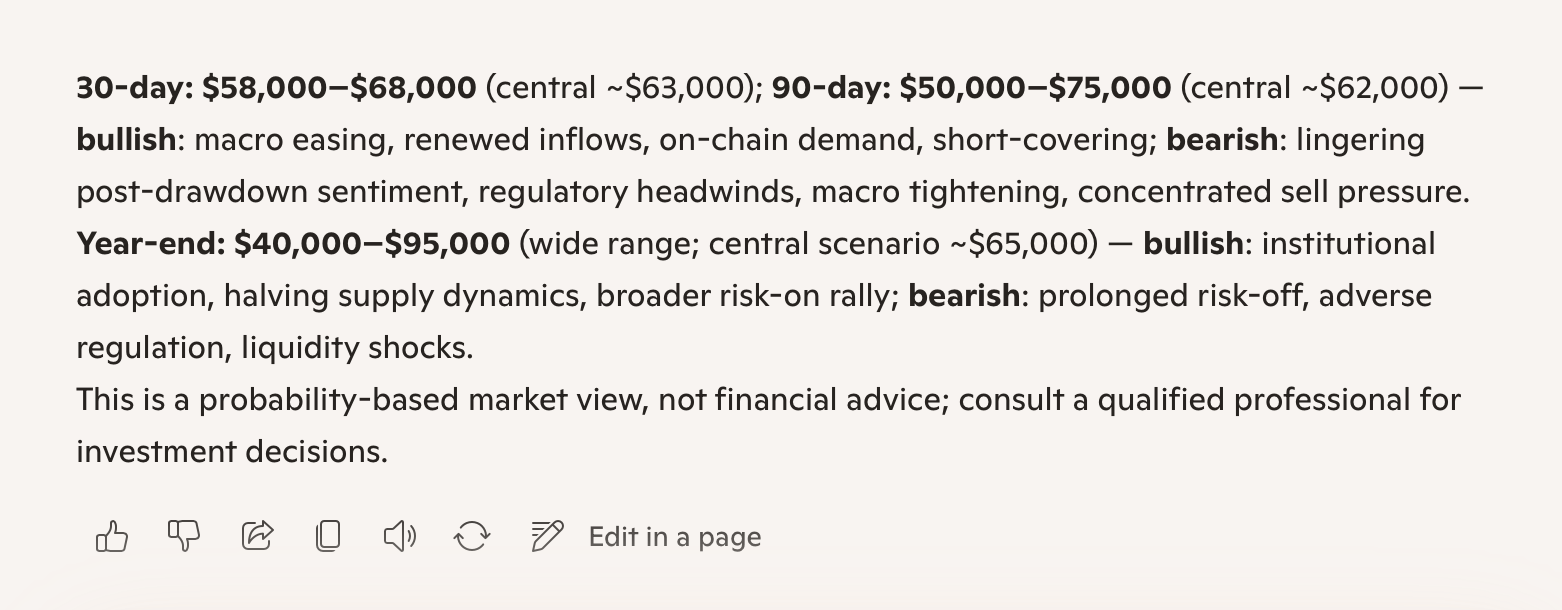
Microsoft Copilot Think Deeper answer:
Venice AI answer:
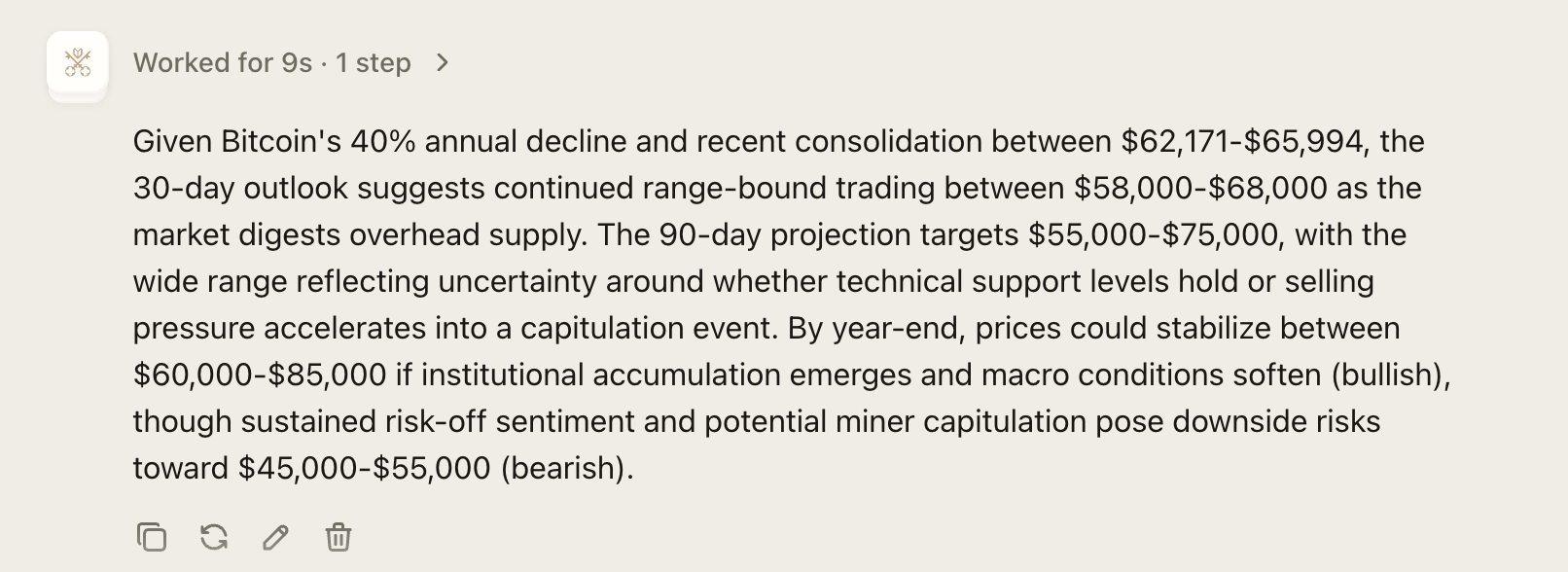
ChatGPT 5.5 High Intelligence answer:
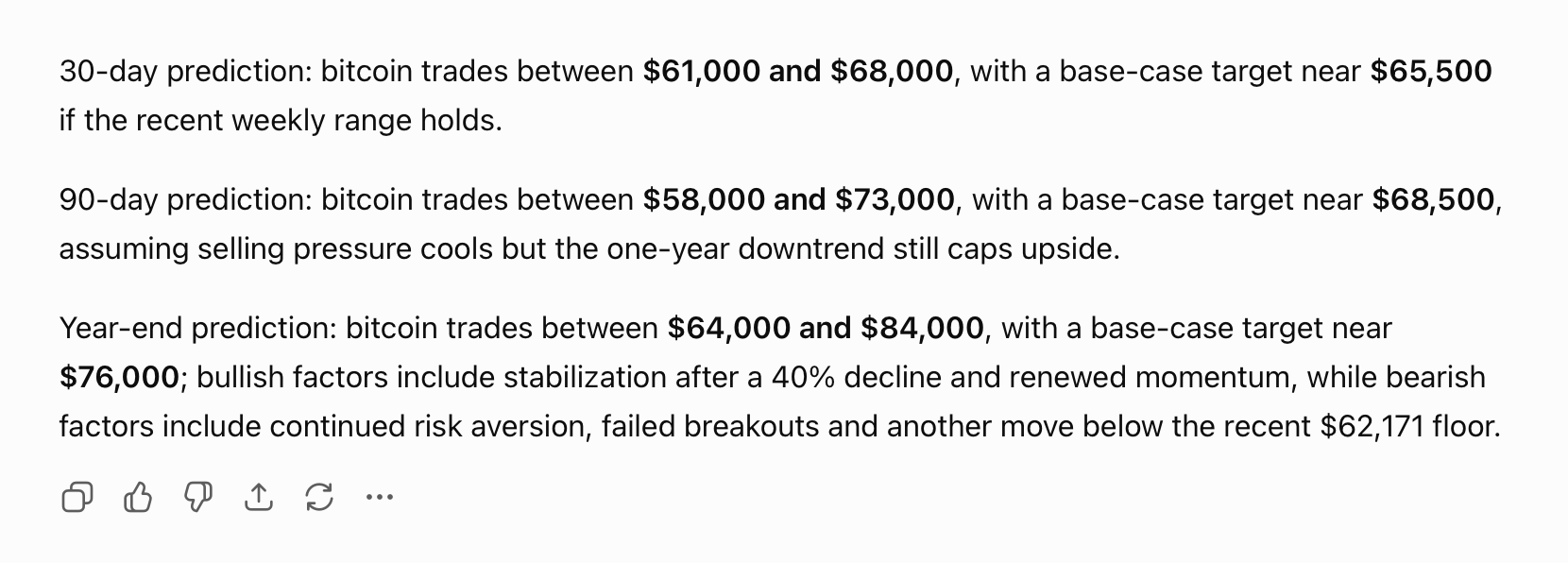
Grok Expert answer:
Based on bitcoin’s 40% decline over the past year and its recent consolidation between $62,171 and $65,994, the 30-day forecast points to a probable trading range of $61,000-$67,000 with a base case near current levels. Extending to 90 days, increased volatility could push the range to $58,000-$70,000 as the longer-term downtrend exerts influence. By year-end, the expected range is $50,000-$75,000, where the primary bullish factor is the potential for stabilization following the recent tight range and the main bearish factor remains the persistent yearly downward momentum.
Claude Opus 4.8 High Intelligence answer:
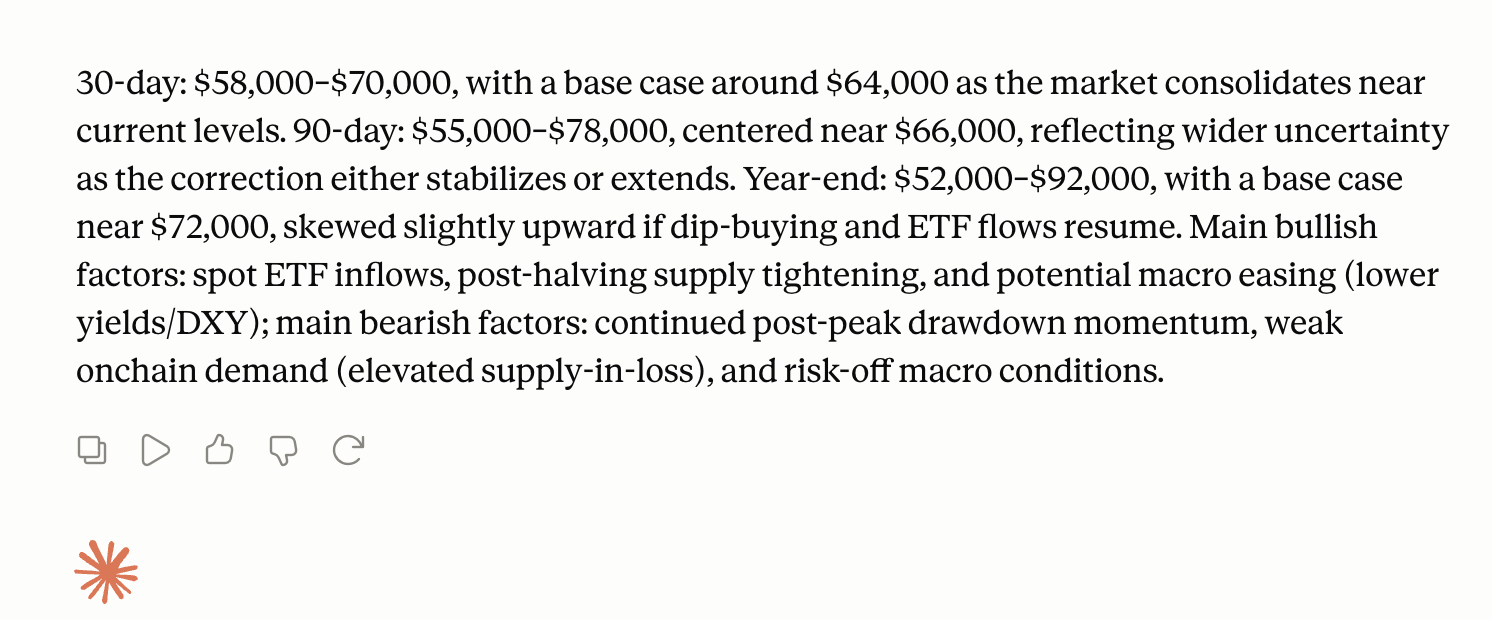
Deepseek Deepthink answer:
30-day: $60,000–$66,000; 90-day: $58,000–$70,000; year-end: $55,000–$75,000. Bullish factors include potential support near the weekly low and mean-reversion buying after a steep yearly decline, while bearish factors center on the persistent 40% yearly downtrend and resistance at the weekly high capping upside. Probabilities lean moderately bearish over the longer horizon given the existing trend, but near-term range-bound action is the most likely outcome.
Pi AI answer:
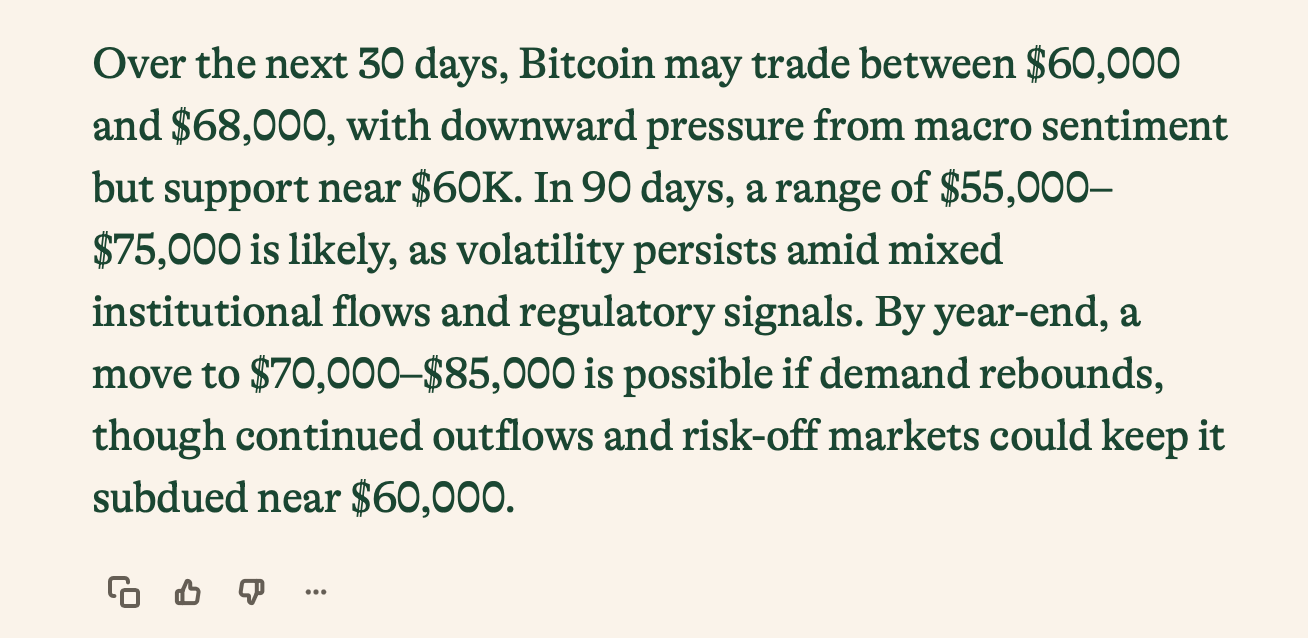
Qwen 3.7 Plus answer:
Given the 40% annual decline, the 30-day prediction is a consolidation between $60,000 and $68,000, the 90-day forecast ranges from $58,000 to $72,000, and the year-end target is $65,000 to $80,000. Bullish factors include oversold conditions and potential accumulation following the significant drawdown, which could drive a mean reversion. Conversely, bearish factors involve lingering downtrend momentum and immediate overhead resistance near the $66,000 weekly high.
Kimi K2.6 answer:
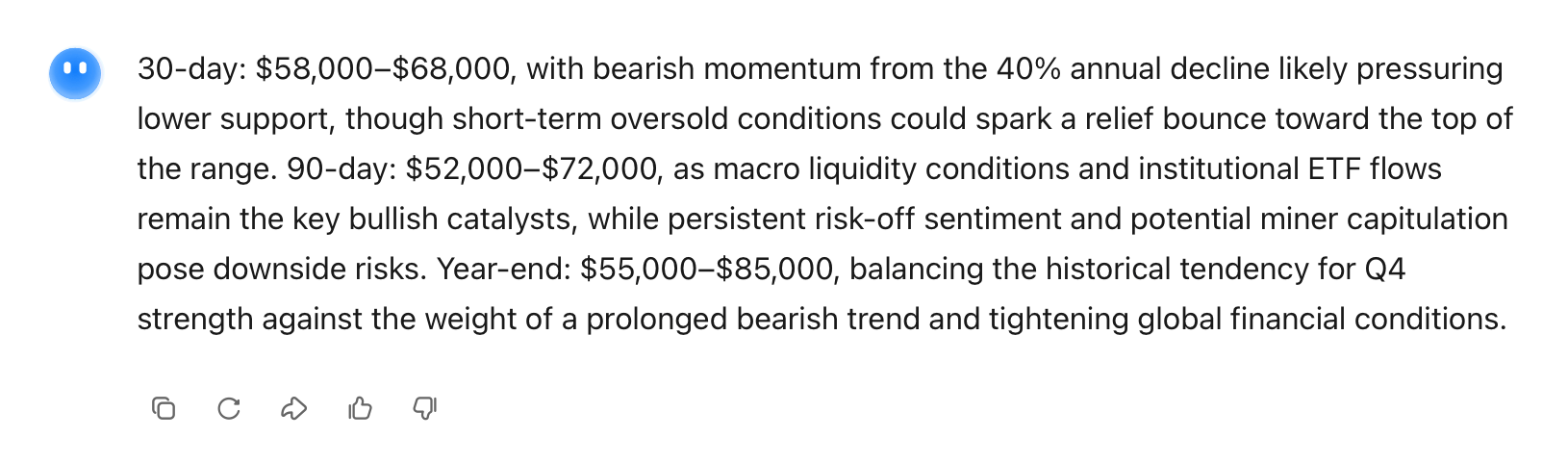
Meta AI answer:
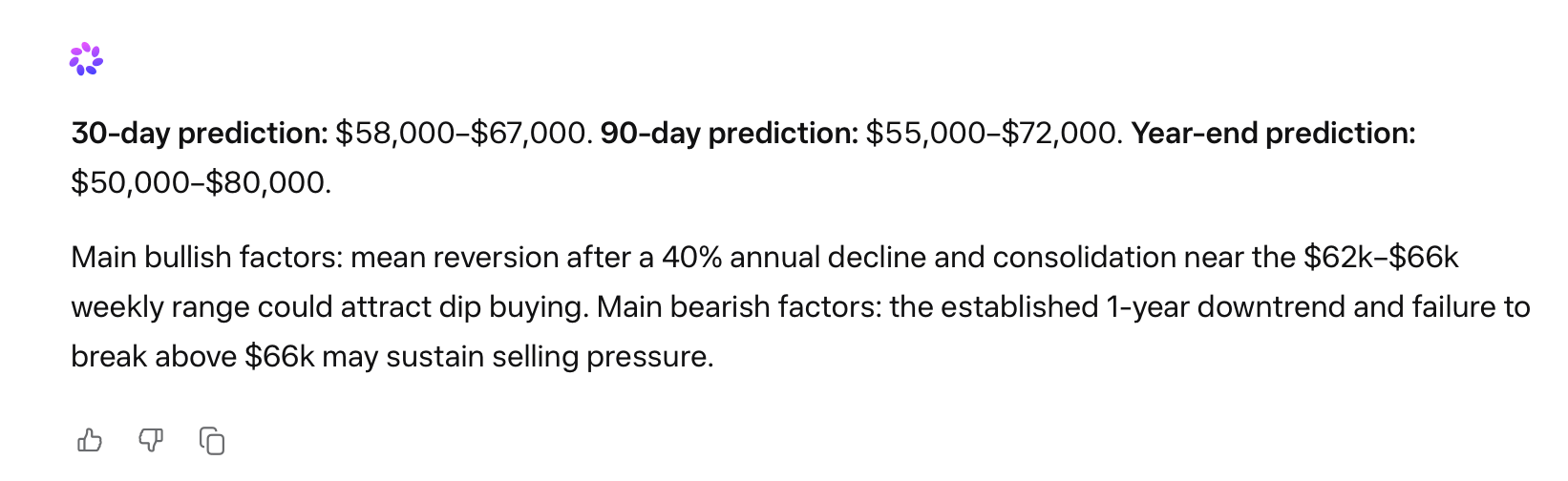
Mistral AI Lechat Fast answer:
30-day: $63,000–$66,000 (range-bound, with resistance at $66K and support at $62K). 90-day: $60,000–$70,000 (potential rebound if macro sentiment improves, or further decline if selling pressure persists). Year-end: $55,000–$75,000 (bullish: institutional adoption; bearish: prolonged macro downturn or regulatory headwinds).
ChatGPT 5.5 Medium answer:
30-day prediction: bitcoin likely trades between $63,000 and $68,500, with modest upside if buyers defend the weekly range and downside risk if momentum weakens below $62,171.
90-day prediction: bitcoin likely trades between $58,000 and $72,000, with a base case near $66,000 as mean reversion battles the broader 40% yearly decline.
Year-end prediction: bitcoin likely finishes between $55,000 and $78,000, with bullish pressure from range recovery and accumulation potential, while bearish pressure comes from the sustained annual drawdown and failure to reclaim higher levels decisively.
Gemini 3.1 Pro answer:
Given the 40% annual decline and recent tight consolidation, the 30-day prediction places bitcoin between $60,000 and $68,000 as the market tests near-term support. The 90-day forecast projects a broader $55,000 to $75,000 range, depending entirely on whether buyers can defend the current $62,171 low. A probability-based year-end prediction targets a recovery toward $70,000 to $85,000, assuming the prolonged sell-off has finally exhausted major supply. A potential mean-reversion bounce from these depressed levels acts as the primary bullish catalyst, whereas a decisive break below the weekly low presents the main bearish risk of further capitulation.
Wide AI Forecasts Reveal a Market Still Searching for Conviction
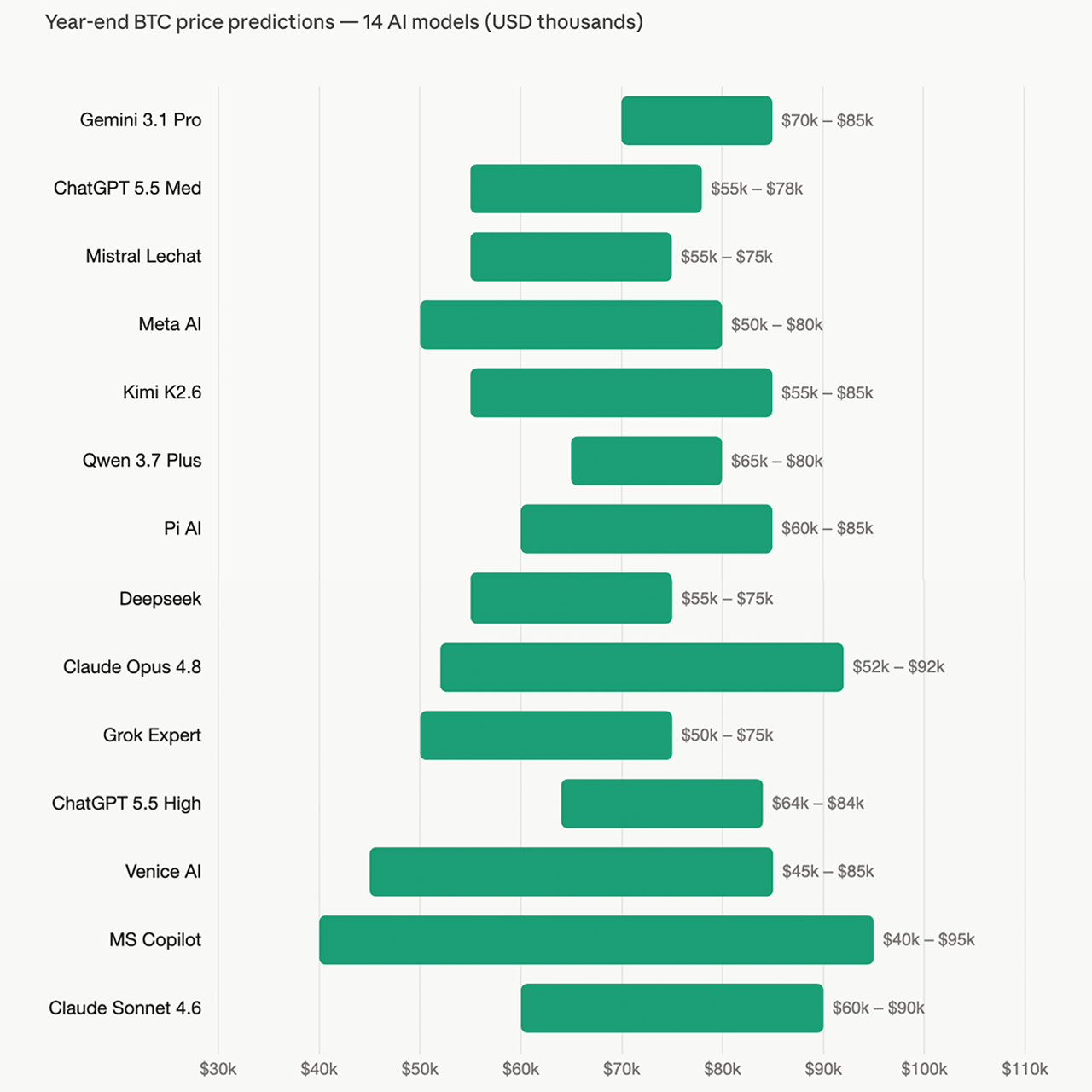
What stands out across these responses is the sheer width of the price bands. Most models offered year-end ranges stretching $40,000 or more, a spread that signals uncertainty rather than precision. That ambiguity closely mirrors the current divide among analysts and prediction markets, though the broader tilt remains mostly bearish.
The consistency across models is also difficult to ignore. Although the responses came from different developers, they followed similar structures, used similar framing, and leaned on familiar talking points, from halving-driven supply dynamics to ETF inflows and macro easing. That convergence suggests these systems are drawing from overlapping pools of training data and often produce consensus-style outputs when handed identical prompts.
Ultimately, the experiment says as much about AI forecasting as it does about bitcoin. The models clustered around cautious ranges, not bold calls, reflecting a market defined by damaged momentum, fragile support and limited conviction. Their shared assumptions point to a consensus machine that can map uncertainty clearly, but not resolve it. For readers, the takeaway is simple: prediction bands are wide because bitcoin’s next move remains unsettled for now.

Strategy should halt its bitcoin purchases and rebuild its cash reserves, research firm Cryptoquant warned, after the company's dividend coverage…
Read Now: Strategy Should Pause Bitcoin Buys and Rebuild Cash, Cryptoquant Warns as STRC Stays Below Par